Blog
Why a Feature-Rich Event App Still Isn’t Driving Engagement
Daniel’s team has spent months preparing the technology for a 1,000-person industry conference.
The event platform has everything they expected it to need.
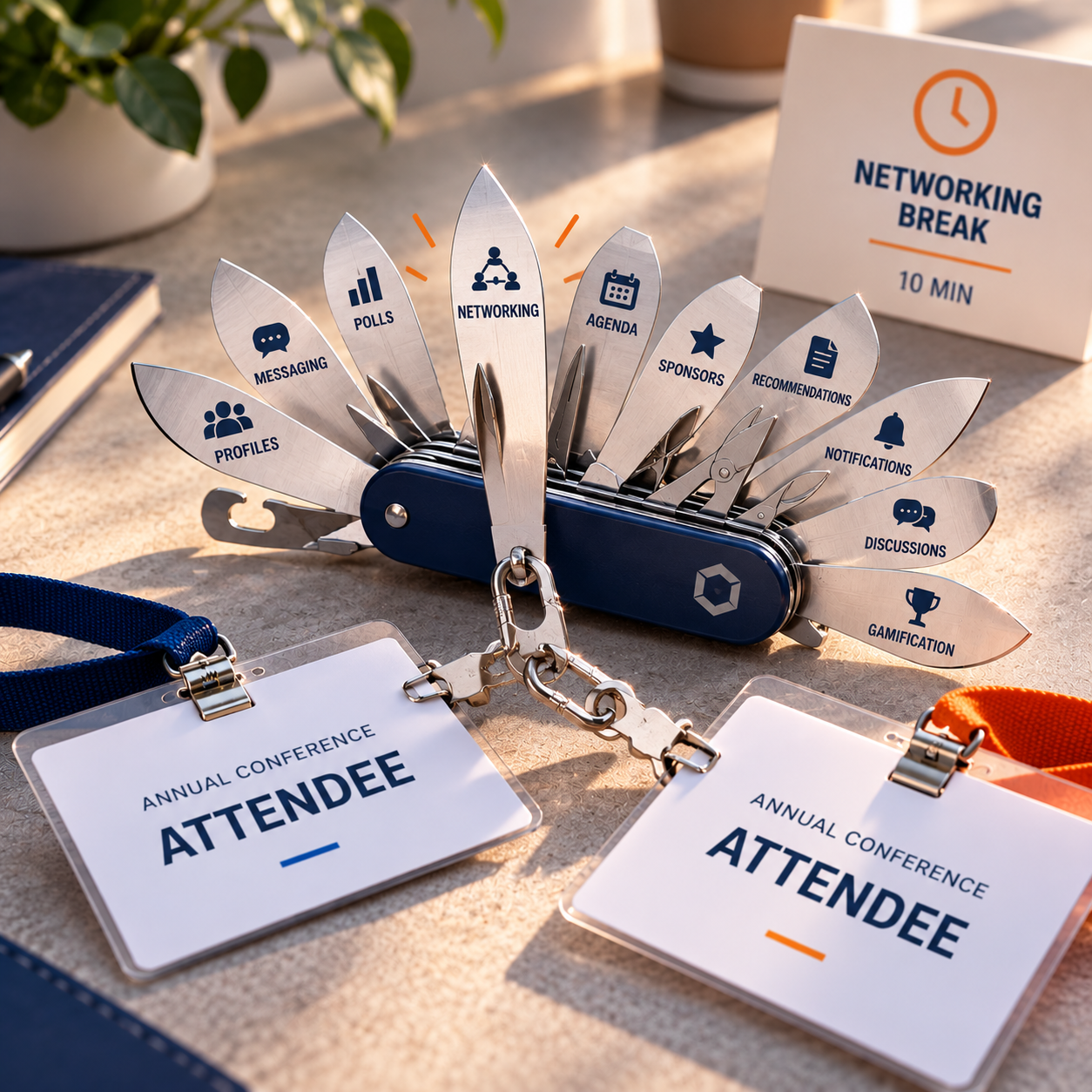
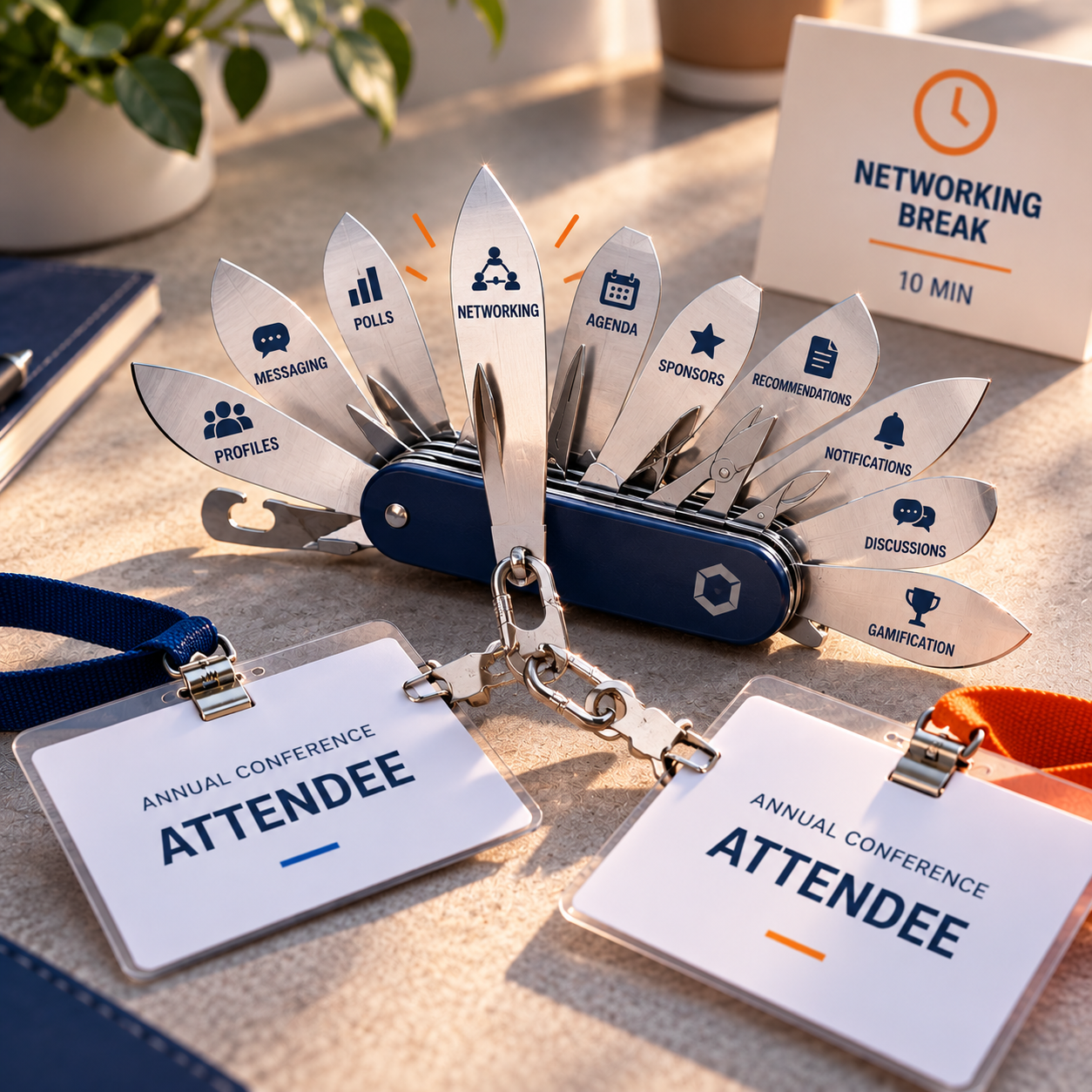
Attendee profiles. Messaging. Polls. Networking. Sponsor pages. Session recommendations. Notifications. Discussion spaces. Gamification.
During procurement, the feature checklist looked comprehensive.
By lunchtime on day one, the experience looks different.
Attendees are using the agenda. Some check notifications. A few browse profiles.
But many of the features designed to create interaction are barely influencing what people actually do.
The technology works.
The capability exists.
The behaviour has not followed.
A feature makes an action possible. Engagement depends on whether someone sees enough relevance and value to take that action in the moment.
Those are not the same thing.
And when a feature-rich platform is being used but still not changing attendee behaviour, the more useful question is not what else to add.
It is where the participation journey is breaking down.
Engagement Is Not a Feature
A platform can enable messaging.
It cannot guarantee people will message one another.
It can provide attendee profiles.
It cannot guarantee people will find someone worth meeting.
It can include polls.
It cannot guarantee the question will feel worth answering.
It can create discussion spaces.
It cannot guarantee anyone will have a reason to contribute.
Features create capability.
Engagement is behaviour.
That behaviour happens inside a live environment where attendees are already deciding:
- where to go next
- whether to join a conversation
- which session matters
- whether to visit a sponsor
- whether to answer a work message
- who might be worth speaking with
The platform is competing for attention inside that environment.
That makes the more useful question:
What is the app helping the attendee do right now?
Why Feature Completeness Can Be Misleading
Feature checklists are useful when choosing technology.
Teams need to know whether a platform can support what their event requires.
The problem begins when having the capability becomes confused with creating the outcome.
Consider networking.
A platform might include:
- attendee profiles
- search
- filters
- messaging
- meeting requests
Technically, the networking capability is there.
But an attendee can still open the directory and wonder:
Who here should I actually speak to?
They may see 800 profiles and no obvious reason to choose one over another.
The missing element is not necessarily another networking feature.
It may be:
- relevance
- context
- timing
- confidence
- a clearer first step
For more on this distinction, see Why Attendees Leave Events Without Making the Right Connections.
A Better Engagement Model
Instead of thinking:
Feature → Engagement
use a more realistic sequence:
Context → Relevance → Prompt → Action → Value → Return
Each stage matters.
Context
Does the attendee understand what is happening and why this matters now?
Relevance
Can they see why the action is useful to them?
Prompt
Is there a clear reason to act at this moment?
Action
Is the next step easy enough to take?
Value
Did something worthwhile happen because they acted?
Return
Was the experience useful enough that they have a reason to come back?
A feature may support one or several stages.
But the feature alone does not complete the journey.
1. Context: Does the Feature Fit the Event Moment?
Timing changes how useful technology feels.
Imagine receiving a networking recommendation during the keynote.
It might be a perfectly good match.
It is still the wrong moment.
Now imagine receiving it ten minutes before the networking break.
The context is different.
The attendee has:
- time to act
- a natural opportunity to meet
- a reason to look
- an obvious next moment
The same capability becomes more useful because it fits what is happening around it.
Good event technology should support the rhythm of the event rather than operate as a separate digital layer demanding attention.
2. Relevance: Why Should the Attendee Care?
A generic feature asks people to interpret its value themselves.
For example:
Explore attendees
provides access.
But:
Three people attending this afternoon are also working on member retention
provides relevance.
Or compare:
Join the discussion
with:
Several attendees from the workforce session are continuing the question about regional skills shortages
Again, the capability may be identical.
What changes is whether the attendee can immediately see why it may be worth their attention.
That matters because live events leave little time for exploration without purpose.
3. Prompt: Make the Next Step Visible
A useful capability can still sit unused if attendees do not know when to act.
The prompt connects opportunity to timing.
A good prompt does not simply say:
Use this feature.
It helps answer:
Why now?
For example:
Before a Networking Break
Heading to lunch? See attendees open to conversations around workforce planning.
After a Session
Want to continue the discussion? Join others interested in the same topic.
Before the Expo
Looking for solutions in member engagement? See which partners are working in that area.
The technology is not asking for attention for its own sake.
It is helping the attendee navigate something they are already doing.
4. Action: Reduce the Work Between Interest and Participation
Even when an opportunity is relevant, the next step may still require too much effort.
Suppose someone wants to meet another attendee working on the same challenge.
The process might involve:
- opening networking
- selecting filters
- searching profiles
- reading biographies
- deciding who seems appropriate
- composing a message
- waiting for a reply
None of those steps is particularly difficult by itself.
Together, they create friction.
A better experience may use the same underlying functionality while reducing the effort required to move from:
That looks relevant
to:
I’ll take the next step.
That could mean:
- surfacing shared interests
- suggesting a small number of relevant people
- showing whether someone is open to connecting
- offering an easy introduction
- connecting people through a topic discussion
The aim is not to remove choice.
It is to remove unnecessary work.
5. Value: What Happened Because They Used It?
This is where engagement measurement can become too platform-focused.
The click is not necessarily the outcome.
The message is not necessarily the outcome.
The profile view is not necessarily the outcome.
The useful question is:
What became possible because of that interaction?
Maybe the attendee:
- found someone worth meeting
- joined a relevant discussion
- discovered a useful session
- received an answer
- found a sponsor that matched their needs
- continued a speaker conversation
- discovered another part of the community
That tells the organiser more than simply reporting that the feature was used.
The best digital interaction may ultimately result in something valuable happening away from the screen.
6. Return: Did the Experience Earn Another Visit?
Repeat usage is often treated as something organisers need to manufacture through reminders.
But people also return because something has already proven useful.
If an attendee opens the platform and quickly finds:
- a relevant person
- a useful activity
- an answer
- an important update
they have learned something:
Opening this may be worth my attention.
If their first experience is mostly navigation, searching and uncertainty, another notification may not change that perception.
Return behaviour begins with the quality of the earlier interaction.
More Features Can Sometimes Create More Friction
This needs nuance.
Additional capability is not inherently bad.
Sometimes a missing feature genuinely prevents the event from delivering the intended experience.
But every additional option also creates a design question:
When should the attendee see it?
A platform might contain:
- networking
- messaging
- polls
- sponsor content
- discussions
- recommendations
- gamification
- meeting booking
- resources
If every option receives equal attention, the attendee has to decide what matters.
The product may be technically comprehensive while the experience feels unclear.
The stronger principle is not:
Fewer features are always better.
It is:
The attendee should not have to process the full complexity of the platform to find the one useful action that matters now.
The App Should Support the Event, Not Become the Event
The goal of an event app should not be maximum screen time.
That would be a strange measure of a successful live event.
The technology should help attendees participate more effectively in what is happening around them.
Before the Event
Help people arrive with context.
They might identify:
- relevant topics
- useful sessions
- people they may want to meet
- groups they could join
As explored in Great Events Don’t Start Cold, the event does not need to begin with everyone starting from zero.
During the Event
Help attendees recognise the next useful opportunity.
That may be:
- a person
- a discussion
- a session
- an introduction
- a sponsor
- a contribution
After the Event
Help useful moments continue.
That might mean:
- reconnecting with someone
- continuing a topic
- joining another community activity
- following up on an introduction
Technology becomes more valuable when it supports the event journey instead of competing with it.
How to Diagnose a Feature-Rich but Engagement-Poor App
Before changing the platform, look at where the behaviour is breaking down.
| What you see | Possible issue | What to investigate |
|---|---|---|
| Feature is rarely opened | Weak relevance or visibility | Do attendees understand when and why to use it? |
| Feature gets views but little action | Unclear next step | Is participation easy enough to start? |
| People act once but do not return | Weak perceived value | Did the first interaction accomplish anything worthwhile? |
| Notifications get opened but ignored | Prompt without enough value | Does the message lead to something relevant? |
| Networking directory gets traffic but few connections | Discovery without initiation | Can attendees recognise useful people and start naturally? |
| Engagement is strong only during event day | No continuation pathway | Is there a reason to use the platform afterwards? |
These patterns help organisers distinguish between a true feature gap and an experience gap caused by weak relevance, timing, friction or follow-through.
The point is not to blame the interface for everything.
It is to identify whether the gap sits in:
- capability
- relevance
- timing
- friction
- value
- continuation
Different problems need different solutions.
Measure Engagement Beyond Feature Usage
Feature analytics still matter.
They can help show where behaviour begins or stops.
But they become more useful when paired with outcomes.
| What to capture | What it can help reveal | What decision it informs |
|---|---|---|
| Feature views | Initial discovery | Whether the capability is visible enough |
| First action | Willingness to participate | Whether the next step is clear |
| Return use | Repeat usefulness | Whether value was strong enough to come back |
| Introductions accepted | Networking relevance | Whether suggested connections feel worthwhile |
| Discussion participation | Topic interest | Which conversations deserve support |
| Post-event continuation | Ongoing value | Whether engagement has somewhere to go |
The better question is not:
Which feature had the most clicks?
It is:
Which part of the experience helped people do something useful, and where did the journey stop?
Start With the Behaviour You Want to Enable
Before requesting another feature, ask:
What should attendees be able to do more easily because this technology exists?
Maybe they should be able to:
- find someone relevant
- join a discussion
- contribute to a session
- identify an appropriate sponsor
- reconnect afterwards
Once the desired behaviour is clear, the team can ask whether the existing capability supports it.
Sometimes the answer will be:
We genuinely need another feature.
Other times, the technology already does enough.
The better opportunity may be to improve:
- context
- relevance
- timing
- guidance
- friction
- follow-up
That is a more useful way to think about event engagement than feature count alone.
Common Mistakes With Feature-Rich Event Apps
Mistake 1: Assuming Capability Creates Behaviour
A feature makes an action possible.
It does not guarantee anyone will take it.
Mistake 2: Showing Everything at Once
Technical completeness does not require every option to compete for attention simultaneously.
Mistake 3: Treating Usage as the Final Outcome
Clicks and views matter.
Ask what they led to.
Mistake 4: Asking Attendees to Discover the Value Themselves
Help people see why something matters in the moment.
Mistake 5: Ignoring Social Friction
Networking may technically be easy while still feeling socially difficult.
Mistake 6: Adding Features Before Diagnosing the Gap
Understand whether the problem is capability or experience before expanding the platform.
Mistake 7: Designing Only for Event Day
Useful participation can begin before the event and continue afterwards.
Final Thought
A feature-rich event app can still play a very small role in the attendee experience.
That does not automatically mean the technology is poor.
It may mean the platform makes plenty of actions possible without making the right action clear enough, relevant enough or easy enough in the moment.
The better question is not:
Does our event app have everything?
It is:
Does it help people do the things that matter more easily?
That shifts event technology away from feature accumulation and towards behavioural usefulness.
Because engagement is not created by the number of tools available.
It is created when the experience gives people a clear, worthwhile reason to participate.
Better event engagement does not come from giving attendees more tools to explore. It comes from making the right participation opportunity easier to recognise, easier to start and easier to continue.
Looking to Turn Event Technology Into Useful Participation?
SixSides helps organisers create clearer pathways for attendee discovery, participation and ongoing connection before, during and after events.
If your team has capable event technology but is still trying to understand how to turn that capability into more useful attendee behaviour, the Book a demo option on this page is there if you want to see how this could work in practice.
Give your event a community that lasts
A branded app where members show up before day one and stay long after the close. We'll walk you through it.