Blog
How to Increase Event App Adoption Without Adding More Features
Rachel’s team has already invested in the event platform for their 750-person annual conference.
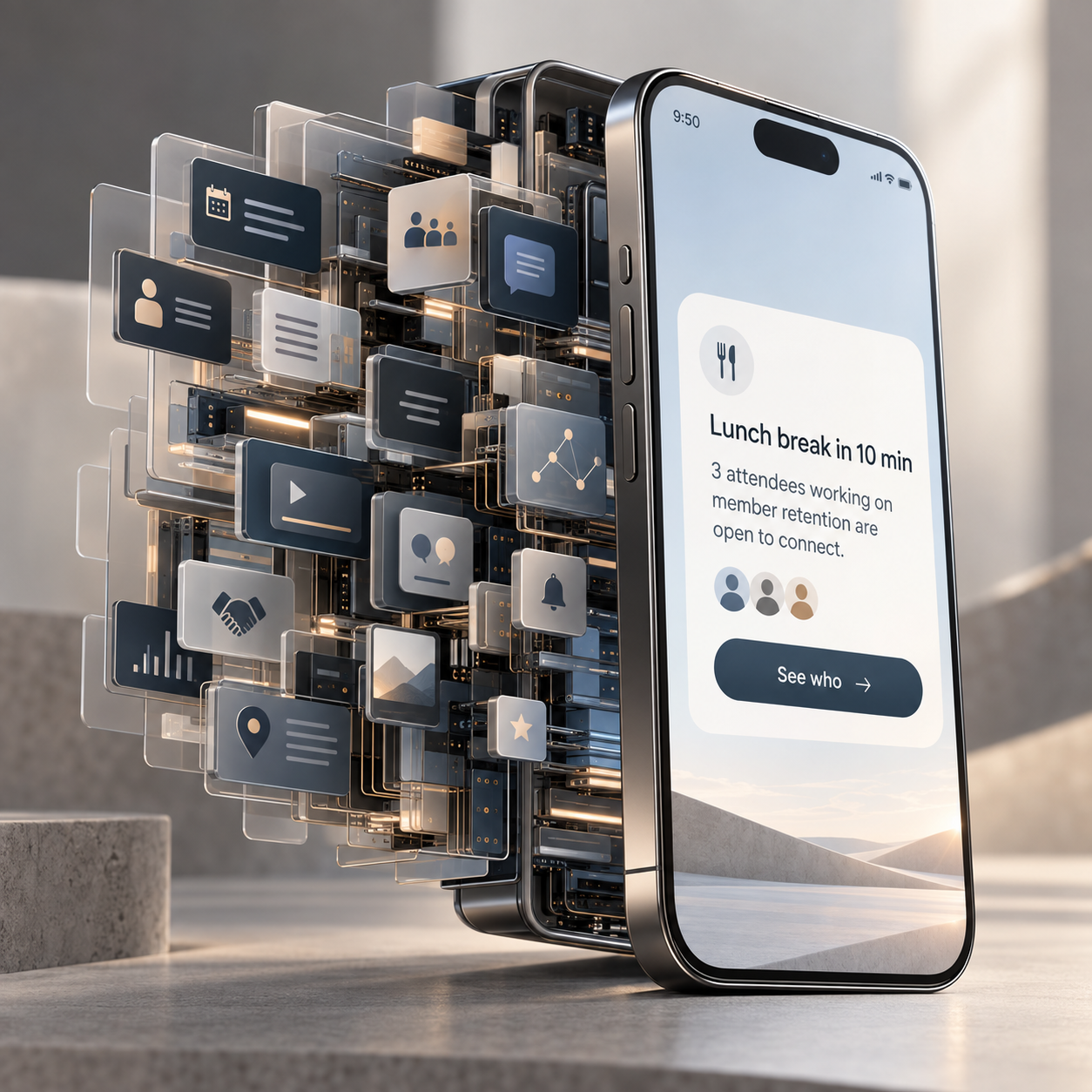
It has an agenda, attendee profiles, messaging, sponsor content, session information, notifications and networking tools.
On paper, there is plenty for attendees to use.
But adoption is weaker than expected.
People download the platform because the pre-event emails tell them to. They check the agenda. Some browse the attendee list.
Then many stop returning.
The immediate instinct is familiar:
Do we need another feature?
Maybe better matching. Another networking tool. More content. More notifications. More gamification.
Sometimes new capability genuinely is the answer.
But before adding anything, there is a more useful question:
Is the problem actually missing functionality, or are attendees struggling to experience value from what is already there?
If the real barrier is relevance, timing, friction or a weak reason to return, adding another feature may simply add another thing people have to understand.
Better event app adoption often starts by identifying where the attendee journey is breaking down.
Adoption Is More Than Downloads
A download is useful to measure.
It tells the organiser that someone crossed the first access barrier.
But installation is not the same as adoption.
A more useful adoption journey looks something like:
Download → First useful action → Return → Repeated value
Someone who downloads the platform, checks the agenda once and never returns has technically accessed the technology.
But it has not become useful enough to influence their event experience.
Another attendee might open it before arrival, identify two relevant sessions, discover someone working on a similar challenge and return during the event to continue that interaction.
Those are very different patterns.
So the goal should not simply be:
How do we increase logins?
It should be:
How do we make the platform useful enough that people have a reason to return?
Before Adding Features, Diagnose the Adoption Problem
Weak usage can have several causes.
A missing capability is only one of them.
| What you observe | Possible problem |
|---|---|
| Strong downloads but few repeat users | The first experience did not create enough value |
| Attendees browse profiles but rarely connect | Discovery exists, but the next action is unclear or too difficult |
| Networking tools are available but lightly used | People cannot easily see who is relevant |
| Notifications are opened but rarely acted on | The prompt may not lead to something worthwhile |
| Usage centres almost entirely on the agenda | Other parts of the platform may not have a clear role in the event journey |
| First-time attendees use the platform less | They may need better context and clearer entry points |
Those situations require different responses.
Adding functionality before understanding the problem can make the experience more complicated without fixing the underlying issue.
The Event App Adoption Playbook
A practical adoption strategy can focus on four things:
- Create first value quickly
- Make the next action obvious
- Connect the platform to real event moments
- Create reasons to return
This also helps teams decide whether they need a new capability at all, or whether better relevance, timing and guidance would solve more of the problem.
1. Create First Value Quickly
The attendee’s first meaningful interaction matters.
Imagine opening an event platform for the first time and seeing:
- a long navigation menu
- hundreds of attendee profiles
- sponsor areas
- discussion spaces
- content feeds
- networking options
- programme tools
There may be plenty of useful capability inside.
But the attendee still has to find it.
A stronger first experience helps answer:
Why should I use this?
and:
What useful thing can I do first?
That might mean helping someone:
- save sessions relevant to them
- identify topics they care about
- see who shares those interests
- find first-time attendee information
- discover people from their chapter or region
- respond to one useful pre-event question
The objective is not to introduce everything the platform can do.
It is to help someone experience one worthwhile outcome quickly.
That gives the rest of the experience more context.
2. Make the Next Action Obvious
More choice is not automatically better.
Attendees are already deciding:
- which session to attend
- who to speak with
- when to visit sponsors
- where to eat
- whether to join a discussion
- which messages need attention
- what to do during the next break
The digital experience should reduce some of that decision load rather than add to it.
Compare:
Explore attendees
with:
Three people attending tomorrow are also working on member retention. See who may be relevant.
The first provides access.
The second adds context and direction.
Or compare:
Networking
with:
Heading into the lunch break? See attendees open to connecting around workforce planning.
The underlying capability may be the same.
What changes is how easily someone can recognise why it matters now.
Reduce Steps Between Interest and Action
Once someone recognises value, avoid making them work unnecessarily hard to reach it.
Suppose an attendee wants to find another person working on the same industry challenge.
A high-friction journey might be:
- Open networking.
- Search attendee profiles.
- Decide which filters matter.
- Open several profiles.
- Work out who looks relevant.
- Write a message from scratch.
- Wait and hope they respond.
Each step creates another opportunity to stop.
A lower-friction experience might help them:
- identify shared interests
- receive an appropriate recommendation
- express interest
- accept an introduction
- join a related conversation
The principle is simple:
Do not make attendees perform unnecessary work before they can experience the value.
3. Connect the Platform to Real Event Moments
Adoption becomes harder when the app feels like a separate digital destination.
It becomes more useful when it supports what attendees are already doing.
Before the Event
Attendees might:
- choose interests
- discover relevant people
- save sessions
- respond to a topic prompt
- see which groups will be represented
The purpose is not simply to increase pre-event app usage.
It is to help people arrive with more context.
As explored in Great Events Don’t Start Cold, participation can begin before attendees enter the venue.
Before a Networking Break
Help people recognise who may be useful to meet.
Do not simply remind them that networking exists.
After a Session
Surface unanswered questions, related discussions or other attendees interested in the topic.
During the Expo
Help people understand which sponsors or partners may be relevant to what they care about.
After the Event
Make it easier to reconnect with conversations, topics or people worth continuing with.
The technology is no longer competing with the event.
It is helping attendees navigate it.
4. Give Attendees a Reason to Return
Many adoption strategies focus heavily on the first login.
Sustained usage depends on repeat usefulness.
Ask:
What will be different the second time someone opens this?
If the answer is simply:
The same information is still there.
there may be little reason to return.
A useful second visit might provide:
- a relevant new connection
- an updated programme decision
- a discussion that has developed
- a response to a question
- a timely event prompt
- another activity connected to the attendee’s interests
The participant begins to learn:
Opening this helps me.
That is much stronger than repeatedly asking them to use the platform.
Do Not Confuse More Notifications With More Adoption
When usage is weak, another common response is to send more reminders.
Notifications can help.
But reminders work best when there is worthwhile value behind them.
Compare:
Don’t forget to explore the networking section.
with:
Two attendees interested in the same policy issue are joining this afternoon’s discussion.
The first creates another task.
The second creates context.
The notification is not the value.
It points towards it.
Too many low-value prompts can also teach attendees to ignore future ones.
Use them around moments where there is a clear reason to act.
Simplification Does Not Mean Removing Useful Features
There is an important distinction here.
Reducing friction does not mean removing every sophisticated capability.
The platform may need significant functionality behind the scenes.
Attendees simply do not need all of that complexity presented at once.
Good simplification can mean:
- prioritising what matters in the moment
- reducing unnecessary choices
- changing what appears based on context
- guiding someone towards a useful action
- introducing capability when it becomes relevant
The goal is not to make the technology less capable.
It is to make that capability easier to use.
Adoption Is Also an Event-Design Problem
Organisers sometimes treat low adoption entirely as a product problem.
Part of it may instead sit in the wider event experience.
If attendees do not understand:
- why networking matters
- what the platform will help them accomplish
- what information they should provide
- when particular tools are useful
- what they gain from participating
the interface has to solve all of those problems on its own.
That is difficult.
Event communications, hosts and programme design can reinforce what the technology is trying to enable.
For example, a host might say:
Several people here are working on the workforce challenge we just heard about. You can see who has opted into that topic and continue the conversation during the break.
Now the digital experience has context.
That is very different from expecting people to discover the feature themselves.
Measure Adoption as a Journey
Downloads and logins still matter.
They become more useful when placed inside the wider adoption journey.
| What to capture | What it can indicate | What decision it can inform |
|---|---|---|
| Downloads | Initial access | Whether promotion and onboarding are working |
| First useful action | Early value discovery | Whether the first experience is clear enough |
| Return usage | Repeat usefulness | Whether people have a reason to come back |
| Attendee discovery | Interest in finding relevant people | Whether matching and visibility are working |
| Connection actions | Movement from discovery towards participation | Whether the next step is easy enough |
| Discussion participation | Interest around shared topics | Which conversations deserve more support |
| Post-event activity | Continued usefulness | Whether the platform has a role beyond event day |
This helps teams distinguish between different problems.
High downloads + low first actions may suggest weak onboarding or unclear value.
High first actions + low return usage may suggest the initial experience worked, but there was little reason to come back.
Strong discovery + weak connection activity may indicate that attendees can see potentially useful people but still face too much social or product friction.
Those patterns give organisers a clearer basis for deciding whether to improve onboarding, simplify discovery, refine prompts, reduce friction or adjust how the platform fits into the event journey.
Five Questions to Ask Before Adding Another Feature
Before requesting more functionality, ask:
1. Do Attendees Understand Why the Platform Is Useful?
If not, another feature may make the proposition less clear.
2. Can They Reach Something Worthwhile Quickly?
If useful actions are buried, prioritisation may matter more than capability.
3. Is the Platform Connected to Actual Event Moments?
If it sits apart from the live experience, attendees may forget when to use it.
4. Did the First Interaction Create Enough Value to Justify Another?
If not, investigate the first-use experience.
5. Do We Know Where Adoption Actually Breaks Down?
If not, improve measurement before assuming the solution.
These questions help separate a genuine capability gap from an experience-design problem.
What Better Adoption Actually Looks Like
Better adoption does not necessarily mean attendees spend more time looking at their phones.
That would be the wrong objective.
The platform is doing its job when it helps someone act more effectively.
For example:
An attendee opens it before arrival and discovers someone relevant.
They return during a break because there is an easy way to connect.
After a session, they use it to continue a conversation around the topic.
After the event, they can find that person or discussion again.
The technology supported the event journey.
It did not become the journey.
That is a much more useful definition of adoption.
Common Event App Adoption Mistakes
Mistake 1: Treating Downloads as Adoption
A download proves access.
Return behaviour tells you more about ongoing usefulness.
Mistake 2: Adding Features Before Diagnosing the Problem
Weak adoption may result from missing capability.
But it may also result from relevance, timing or friction.
Know which problem you are solving.
Mistake 3: Showing Everything at Once
Capability does not need to mean complexity for the attendee.
Prioritise what matters now.
Mistake 4: Expecting People to Explore
Live events compete heavily for attention.
Make worthwhile actions easier to recognise.
Mistake 5: Driving Usage Without a Clear Outcome
More clicks are not automatically better engagement.
Ask what someone achieved because they used the platform.
Mistake 6: Waiting Until Event Day to Build Familiarity
Use pre-event moments to establish context before attention becomes fragmented.
Mistake 7: Forgetting About Return Value
One useful interaction is good.
A sequence of useful interactions creates stronger adoption.
A Better Way to Think About Event Technology
Instead of asking:
What else can we add?
ask:
What makes the value we already have easier to experience?
That may lead to a different set of improvements:
- fewer competing choices
- better contextual prompts
- clearer relevance
- easier introductions
- stronger onboarding
- better timing
- more purposeful follow-up
The result is not necessarily a technically simpler platform.
It is a simpler experience for the person trying to use it.
Final Thought
Low event app adoption does not automatically mean the platform needs more capability.
Sometimes it does.
But before adding another feature, understand where the attendee journey is actually breaking down.
Can people see why the platform matters?
Can they reach something useful quickly?
Does it support what they are doing at that moment?
Did the first experience give them a reason to return?
Better adoption begins by answering those questions.
Because the goal is not to give attendees more things to use.
It is to make the useful things easier to use.
Looking to Create a More Useful Event Experience?
SixSides helps organisers create clearer pathways for attendee discovery, participation and ongoing connection before, during and after events.
If your team is looking at how event technology can reduce friction and make worthwhile participation easier without simply adding more features, the Book a demo option on this page is there if you want to see how this could work in practice.
Give your event a community that lasts
A branded app where members show up before day one and stay long after the close. We'll walk you through it.