Blog
Volunteer-Led Member Engagement for Nonprofits: A Practical Guide
Maria helps run a membership-based nonprofit with a small staff team, an active volunteer network and several community events throughout the year. At their quarterly event, volunteers are everywhere. They welcome people at registration, answer questions, help speakers and keep the programme moving.
The event goes well. Several first-time attendees ask how they can stay involved. Others discover people working on similar issues. A few mention that they would be interested in helping at future activities.
Then everyone goes home. The volunteers' roles end with the event. Staff return to their normal workload, and many of the people who were interested in doing something next are left to find that next step themselves.
The volunteers did plenty. The problem is that their role was designed around event delivery rather than participation continuity.
For membership-based and community-led nonprofits, volunteers can play a much more strategic role. They can help people move from attending to connecting, returning and contributing, without being treated as substitute staff or expected to carry the organisation themselves. That is where volunteer-led engagement supports stronger nonprofit community growth. When volunteer interest and participant enthusiasm are visible at events but the organisation has no repeatable way to carry them into another participation step, valuable community momentum disappears between activities.
Volunteer Engagement Is More Than Helping Run the Event
Volunteer support is often organised around practical tasks: registration, room setup, directions, information desks, speaker support, catering and pack-down. Those roles matter, but they mainly help the event operate.
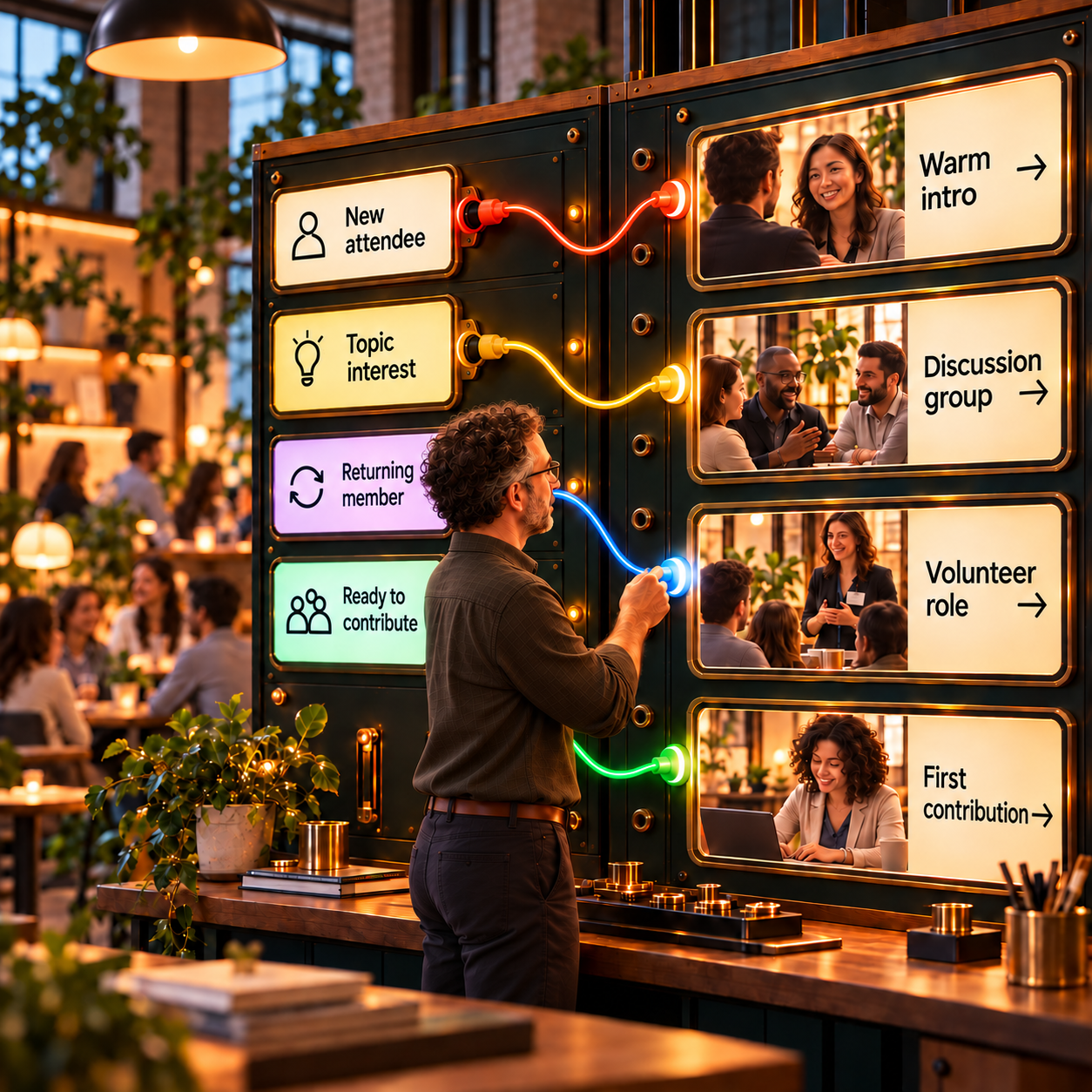
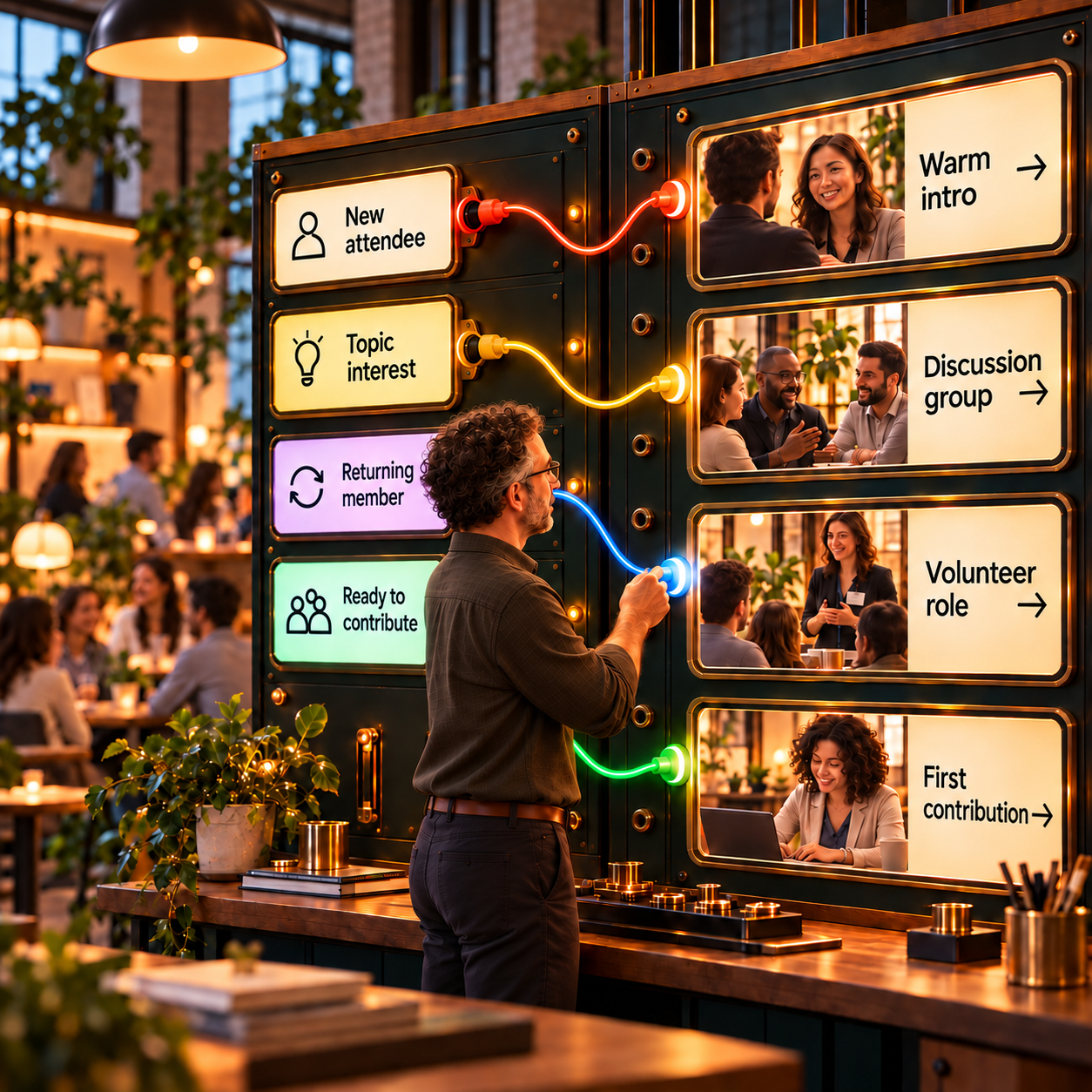
Community participation requires another question: how can volunteers help people find a place in what happens next? That might involve welcoming someone attending for the first time, introducing two people with a shared interest, helping someone discover a relevant activity, continuing a topic discussion after the event, recognising someone who has returned, or giving a potential contributor a small first opportunity to help.
That changes the volunteer brief from "help us run this event" to "help people participate in this community", which is a far more useful role for organisations trying to build year-round engagement.
Why Volunteers Can Be Important to Year-Round Participation
Nonprofit events create useful touchpoints. Members, participants and supporters gather around a shared cause, issue or mission. They meet others, ask questions, discover opportunities and sometimes become more interested in participating than they were before they arrived.
Event momentum does not automatically become ongoing community involvement, though. Someone might leave thinking they would like to meet that person again, help with this, learn more about that issue, or come to something smaller. Or they might simply be interested without knowing where they fit.
Volunteers can help bridge that gap because they are often already part of the community itself. Nobody is asking them to chase everyone afterwards. The aim is to give them clear, lightweight roles at the moments where human guidance is useful.
A Four-Part Volunteer-Led Engagement Framework
A practical model can be built around four things.
Touchpoints. Where do people naturally interact with the nonprofit? That could be annual events, local gatherings, online sessions, programme activities, community meetings, peer groups or volunteer days. These moments reveal interest and create opportunities for connection.
Pathways. What can someone appropriately do next? A good event experience is stronger when there is somewhere for useful interest to continue.
Volunteer roles. Where can volunteers genuinely improve the experience? Not every moment needs staff involvement, but volunteers still need clear responsibilities and boundaries.
Visibility. Can the team see what is continuing? The organisation should be able to understand who is returning, contributing, volunteering or dropping away without relying entirely on staff memory.
Together, these four elements create a practical foundation for volunteer-led engagement. The opportunities tend to appear in recognisable patterns, which means teams can improve them deliberately rather than relying on volunteer instinct alone.
Seven Ways Nonprofits Can Use Volunteers to Strengthen Year-Round Member Engagement
1. Use volunteers to help newcomers find their place
First-time participants often face a different experience from long-standing community members. An established participant may already know who to speak with, what groups exist, how activities work and where they can contribute. A newcomer may know none of that.
A volunteer can reduce some of that uncertainty by welcoming first-time attendees, introducing them to one relevant person, explaining what different activities are for, pointing towards a useful next opportunity and checking in later during the event. Every newcomer does not need a personal guide. What matters is making the first step feel less anonymous, so a simple volunteer interaction helps someone answer where they fit here.
For more on designing that transition, see How Events Can Turn First-Time Attendees Into Active Community Participants.
2. Give event participation a visible next step
An event should not have to carry the entire engagement strategy, but it can reveal what someone may want to do next. One attendee might show interest in a local project. Another may want to reconnect with someone they met. Someone else may ask about volunteering, or become particularly engaged in one topic.
Volunteers can help make relevant next steps visible: another small event, a local group, a topic discussion, a peer introduction, a volunteer opportunity or a follow-up conversation. The role is to make participation easier to continue for those who want it, rather than pushing people into more involvement.
3. Give volunteers specific follow-up roles
One of the weakest volunteer instructions is "help us keep people engaged". It sounds positive and tells the volunteer almost nothing. A better role is specific. For example:
Check in with the three first-time attendees at your table and point each person towards one relevant next activity if they are interested.
Help attendees from the housing discussion find the follow-up peer session next month.
If someone expresses interest in volunteering, make sure that information reaches the staff team.
These are clear, limited responsibilities. They are easier to repeat and easier for volunteers to feel confident doing. Define the boundary too. Volunteers should know what they can decide, what should go back to staff, what information can be shared and when their role finishes. Structure makes volunteering easier, not more bureaucratic.
4. Use volunteers to continue topics that already matter
Events reveal interest. A session fills quickly. One issue generates repeated questions. A particular cause area attracts both new and established participants. Those signals may point towards an opportunity for continued participation.
A volunteer with relevant experience or enthusiasm might help continue the conversation through a discussion circle, a local meetup, a peer conversation, a lightweight online discussion, a follow-up introduction or a member-led topic group. Not every popular topic needs another programme built around it. The useful question is whether this event revealed interest that deserves another place to continue. If the answer is yes, volunteers may help make that continuation easier.
5. Create small contribution opportunities before major volunteer roles
Many organisations unintentionally make the first contribution opportunity too large. Someone attends one event and shows interest, and the next visible option is joining a committee or committing to a formal volunteer role. That is a big jump. A more accessible journey might look like:
Attendee → Return participant → Small contribution → Volunteer → Community contributor
A first contribution could be sharing one resource, welcoming another attendee, helping with one discussion, introducing two people, supporting one small activity or helping host a local meetup. Some people will eventually want larger roles and others will not. Both forms of participation can be valuable. The important thing is that the pathway into contribution feels possible.
6. Build simple systems around volunteer participation
Volunteer-led engagement becomes difficult when every volunteer needs a different briefing and every event creates a different process. Simple, repeatable structures help: a newcomer welcome checklist, short volunteer role guides, follow-up prompts, clear event-to-next-step options, simple handover notes, recurring activity formats and staff escalation points. The aim is to remove unnecessary ambiguity without turning community participation into a rigid process.
Imagine two versions. In the first, a volunteer remembers that someone asked about helping. After the event, they message a staff member. The staff member tries to find the person's details, and someone follows up later. In the second, the volunteer knows how to capture the interest, where it goes and what the next appropriate step is. The human interaction remains and the coordination becomes easier. That is what a useful system should do.
7. Measure what happens after the event
Nonprofit event teams often know how many people attended, how many volunteers helped, how many emails were sent and how many registrations came in. Those numbers are useful, but they do not show whether participation continued.
Better questions include: Who returned? Which first-time participants came back? Which volunteers stayed involved? Who moved from attendee to helper? Which event topics continued? Which follow-up activities attracted participation? Where did people stop engaging? This gives the team a clearer view of whether volunteer-led engagement is helping create continuation.
For more on why attendance alone provides an incomplete picture, see Why Event Attendance Data Is Not Enough to Measure Event Success.
What Volunteer Roles Could Look Like Before, During and After Events
One way to make this practical is to design volunteer responsibilities around the event journey.
| Event stage | Volunteer role | What it supports |
|---|---|---|
| Before | Welcome new participants or answer simple questions | Orientation |
| Before | Connect people around a shared topic where appropriate | Relevant discovery |
| During | Introduce first-time attendees to others | Connection |
| During | Help people find relevant groups or activities | Participation |
| During | Notice interest in volunteering or contributing | Contributor discovery |
| After | Point people towards one relevant next activity | Continuation |
| After | Host a small follow-up conversation | Topic momentum |
| After | Pass useful participation information back to staff | Shared visibility |
Not every nonprofit needs every role. The useful principle is to decide where volunteers add genuine human value rather than assigning responsibilities simply because staff capacity is limited.
Simple Systems Nonprofit Teams Can Build First
You do not need a complex community operations model to begin. Four systems create a useful starting point.
A newcomer welcome path. Decide what should happen after someone's first interaction. For example: first event, then a welcome, then a relevant introduction, then one visible next step. Volunteers can support parts of that journey without owning the entire relationship.
An event-to-next-step pathway. Before each major event, identify the likely ways participation could continue. What could someone interested in this topic do next? Where could a newcomer return? How could someone make a small contribution? Where should volunteer interest go? That makes follow-up easier before the event even begins.
Clear volunteer role guides. Keep them short. A volunteer should understand what their role is, when it happens, what success looks like, where their responsibility stops and who to ask for help.
Shared participation visibility. The organisation needs enough visibility to know who attended, who returned, who expressed interest, who started helping, which topics continued and where follow-up may be needed. Monitoring every interaction is unnecessary. The point is to avoid valuable participation knowledge living only in someone's memory.
What Should Nonprofits Measure?
A practical measurement framework should look beyond volunteer numbers alone.
| What to capture | What it may reveal | What decision it can inform |
|---|---|---|
| First-to-second activity participation | Whether newcomers return | Whether the welcome and next-step journey needs work |
| Repeat participation | Whether people continue finding relevance | Which activities deserve continued support |
| Volunteer continuation | Whether volunteer roles are sustainable | Whether role clarity or support needs improvement |
| Attendee-to-helper progression | Whether small contribution pathways are visible | Whether more entry-level roles are needed |
| Event-to-follow-up participation | Whether event momentum continues | Whether post-event pathways are working |
| Topic continuity | Which interests remain active | What discussions or activities to continue |
| Drop-off points | Where participation stops | Where additional support may help |
| Volunteer-supported follow-up | Where volunteers are helping continuation | Which roles are genuinely useful |
These signals do not automatically prove retention or long-term community health. They help the team identify patterns and decide what to improve.
Volunteer-Led Does Not Mean Volunteer-Managed
This distinction is important. Volunteers can extend a community model, but they should not be expected to replace staff strategy. Staff still need to decide what the organisation is trying to achieve, which participation pathways matter, how volunteer roles are structured, what needs professional oversight, how information is handled, where safeguarding or privacy responsibilities sit, and when volunteers should hand something back to staff.
Organisational leadership is still needed with a strong volunteer network. What changes is that more of the participation experience can be supported by people already inside the community.
Common Volunteer-Led Engagement Mistakes
Treating volunteers as event-day labour only. Event operations matter, and volunteers can also support welcome, connection and continuity.
Asking volunteers to "drive engagement". That is too broad. Give people clear, achievable participation roles.
Expecting first-time attendees to find their own way back. A positive event experience does not automatically reveal the next step.
Making the first contribution too big. Create smaller ways for people to help before asking for major commitments.
Sending the same follow-up to everyone. Different people leave an event interested in different things.
Relying on staff or volunteer memory. Useful signals disappear when they are never captured or shared.
Measuring volunteer numbers instead of continuation. Knowing how many volunteers attended is useful. Knowing whether volunteer involvement helped more people return, connect or contribute tells you more about the participation model.
A Simple Volunteer-Led Engagement Check
Before your next event, ask:
- Do newcomers know where to begin?
- Can volunteers help them find a relevant person or next step?
- Are volunteer roles specific enough to repeat?
- Is there somewhere for useful event interest to continue?
- Can someone contribute without making a major commitment immediately?
- Do staff know what volunteers discovered or supported?
- Can the team see whether people returned afterwards?
If several answers are no, recruiting more volunteers may not solve the problem. The participation pathway may need attention first.
Volunteers as Part of the Participation Model
Volunteers can play a much bigger role in nonprofit community growth than helping an event run smoothly. They can help a newcomer feel recognised, make an introduction easier, show someone what happens next or keep an important topic moving. That works best when volunteers are part of a clear participation model with specific roles, rather than simply being asked to do more.
Volunteer-led member engagement is strongest when volunteers help make participation easier to enter, easier to continue and easier to grow into contribution. That gives nonprofit teams something more useful than extra hands on event day. It gives the community more people who can help others find a place, a next step and a reason to return.
Looking to Strengthen Volunteer-Led Community Participation?
SixSides helps community-led organisations create clearer pathways for discovery, participation, connection and ongoing momentum before, during and after events. If your nonprofit wants volunteers and event touchpoints to support stronger year-round participation without placing every interaction on a small staff team, book a demo.
Give your event a community that lasts
A branded app where members show up before day one and stay long after the close. We'll walk you through it.