Blog
How to Run Peer-Learning Roundtables at Conferences
How to Run Conference Roundtable Discussions That Create Useful Peer Learning
An Australian professional association is planning its annual conference. The programme already includes presentations, panel discussions and networking opportunities, but the organising team wants to create a session where members can compare how they are approaching a shared industry challenge.
They decide to add a roundtable on workforce development. The topic is relevant and there is plenty for members to discuss, but simply putting interested people around a table does not guarantee useful peer learning.
Without a clear purpose, conference roundtable discussions can remain broad, move between unrelated issues or become dominated by the participants most comfortable speaking. Other attendees may listen politely without ever getting to the practical experiences they came to hear.
A better planning question is:
What should participants leave the table knowing, understanding or considering that they did not have when they arrived?
That question changes how the organiser designs the session.
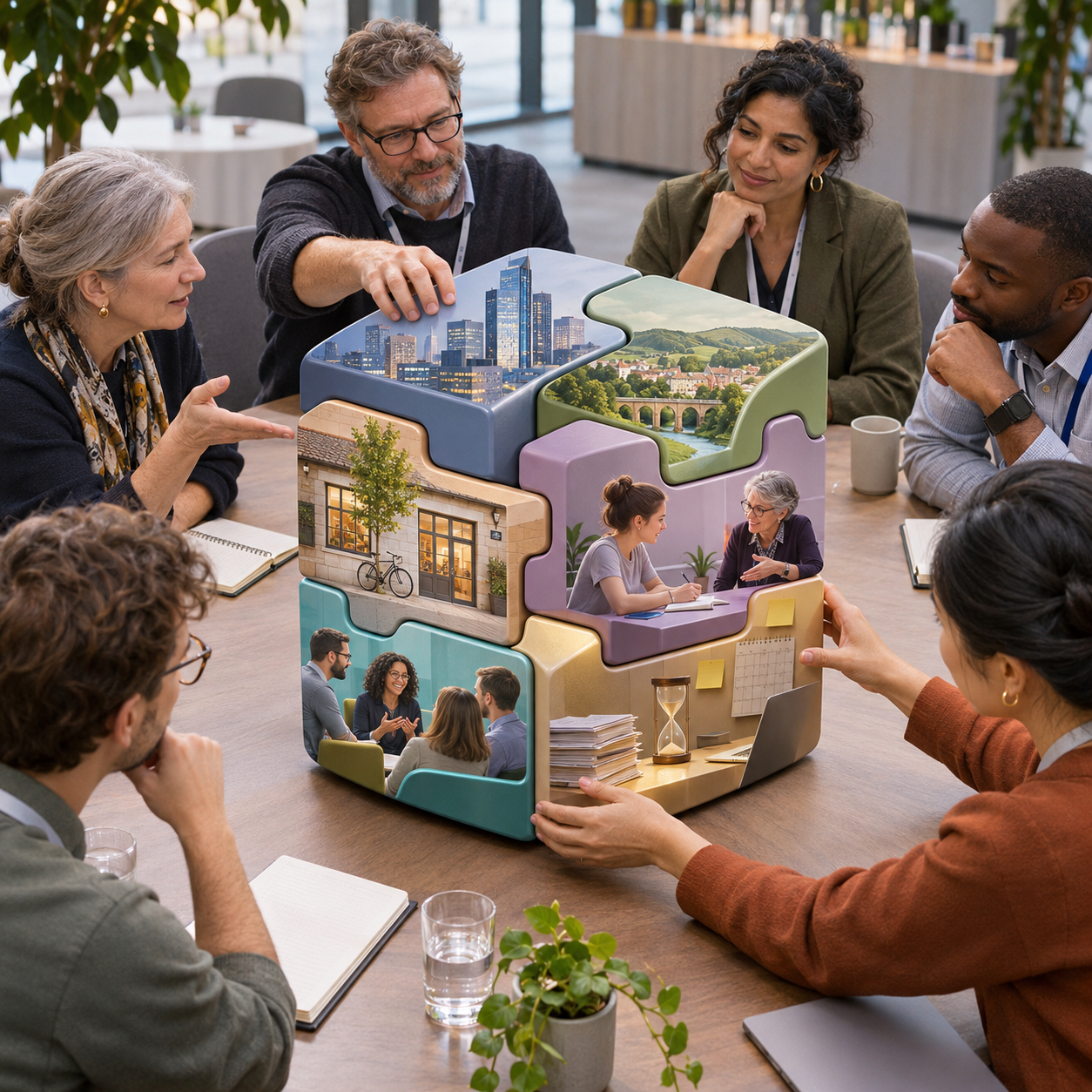
A worthwhile peer-learning roundtable is not simply a conversation around a table. It is a deliberately designed opportunity for participants to compare experiences, explore a shared challenge and learn something useful from one another.
First, Decide Whether a Roundtable Is the Right Format
Roundtables are useful, but they are not automatically the best choice for every conference topic. The right format depends on what the organiser wants participants to get from the session.
Presentation
A presentation works well when the primary purpose is to communicate information, explain a concept or share a particular body of expertise. The knowledge flow is mainly from the presenter to the audience.
Panel Discussion
A panel is useful when attendees want to hear different perspectives from a selected group of speakers or experts. There may be audience participation, but the central voices remain the panellists.
Workshop
A workshop is appropriate when participants need to practise something, complete an activity or work towards a clearer output. The structure is usually more directed than a roundtable.
Peer-Learning Roundtable
A peer-learning roundtable works best when participants themselves bring useful experience to the discussion. The value comes from comparing what different people have tried, what they have learned and how different circumstances have shaped their decisions.
That means a roundtable may be the wrong format when participants do not yet have enough context to contribute, the topic requires structured instruction or the organiser primarily wants to communicate information.
Use a roundtable because peer experience is part of the content, not simply because an interactive session sounds more engaging.
Start With a Specific Learning Purpose
One of the easiest ways to weaken a roundtable is to begin with a topic that is too broad.
Compare these two versions.
Broad topic: Workforce challenges in our industry.
More useful roundtable purpose: How are organisations adapting their approaches to recruiting and supporting early-career professionals across regional and metropolitan teams?
The second gives participants something more specific to explore. It also makes the next planning decisions easier because the organiser can identify whose experiences are relevant and which questions are most likely to produce useful comparison.
A simple planning framework can help.
| Planning question | What organisers should establish |
|---|---|
| What shared challenge are we exploring? | Identify a specific issue relevant to participating members. |
| Why does this discussion need peer input? | Determine what participants can learn by comparing experiences rather than listening to a presentation. |
| Who has relevant perspectives? | Identify roles, contexts or experiences that can add useful differences. |
| What should participants leave with? | Define a realistic learning outcome rather than demanding consensus. |
| What is outside the discussion's scope? | Give the facilitator a boundary when the conversation becomes too broad. |
| What should happen with useful insights? | Decide whether themes should be recorded, shared or simply retained by participants. |
A useful purpose does not need to promise a formal recommendation or solution. Participants might leave with two approaches they had not considered, a better understanding of why another organisation handles the problem differently, or a question they want to investigate further.
Those can all be worthwhile outcomes.
Choose Participants for Relevant Perspective, Not Status
The participant mix has a major influence on the quality of a peer-learning discussion.
For an association conference, useful differences might come from organisation size, geography, specialisation, responsibility, career stage or different approaches to the same problem.
Imagine a roundtable about supporting early-career professionals. If everyone at the table represents a large metropolitan organisation with a formal graduate programme, the discussion may be useful but narrow.
Including participants from regional teams, smaller organisations or workplaces using less formal development models can expose the group to different constraints and approaches.
That does not mean organisers should pursue variety for its own sake. Every participant still needs a relevant reason to be part of the discussion.
Questions worth considering include:
- Who has practical experience with this issue?
- Which perspectives may otherwise be missing?
- Will participants feel able to contribute?
- Is the group small enough for meaningful discussion?
- Should people choose their own topic or be invited based on relevant experience?
- Could seniority or commercial relationships make open discussion more difficult?
There is no universal number that guarantees a successful roundtable. If the group becomes too large for meaningful contribution, the organiser may need several smaller tables, additional facilitators or a more structured participation format.
The objective is not to assemble the most senior people in the room. It is to bring together people whose experiences can help one another understand the issue more clearly.
Prepare Questions That Ask for Experience, Not Just Opinion
The quality of the questions often determines whether a roundtable remains abstract or becomes genuinely useful.
Compare:
What are your thoughts about workforce challenges?
with:
What is one approach your organisation has tried to support early-career professionals, and what have you learned from the results?
The first invites opinion. The second invites experience.
That distinction matters in peer learning because participants are often most useful to one another when they can explain what they actually tried, why they tried it and what they learned.
A simple sequence might move through four stages.
1. Establish the Current Situation
Ask participants what they are experiencing in their own organisations. This gives the group enough context to understand where perspectives differ.
2. Explore Practical Approaches
Ask what participants have tried and what influenced those choices. This moves the conversation from identifying problems to comparing responses.
3. Compare Lessons
Explore what worked, what did not and why different organisations may have reached different conclusions. This is often where the most useful peer learning happens.
4. Identify Useful Takeaways
Ask what participants might test, adapt, investigate or think about differently after the discussion.
The facilitator does not need a long list of questions. A small number of well-designed prompts usually gives participants more room to explore relevant examples.
The questions should guide the discussion without turning the session into a rigid interview.
Give the Session Enough Structure Without Over-Engineering It
A roundtable needs structure, but too much structure can undermine the reason for choosing a discussion format in the first place.
For a 60-minute session, an organiser might use something like this:
| Time | Activity | Purpose |
|---|---|---|
| 0–5 minutes | Welcome and discussion purpose | Clarify why the group is there and what the discussion will explore. |
| 5–15 minutes | Participant perspectives | Give participants enough context about the experiences represented at the table. |
| 15–35 minutes | Main discussion | Explore practical approaches, examples and challenges. |
| 35–50 minutes | Compare lessons | Identify similarities, differences and implications. |
| 50–60 minutes | Takeaways and close | Help participants identify useful learning and appropriate next steps. |
This is an example rather than a formula. Some topics need more time for participants to understand each other's context, while others may benefit from a shorter opening and longer comparison period.
The principle matters more than the exact timing:
Give participants enough structure to stay purposeful and enough flexibility for unexpected insights to emerge.
Facilitate Balanced Participation Without Controlling the Conversation
The facilitator does not have to be the most knowledgeable person at the table. Their primary job is to help the group explore the subject productively.
That begins with establishing the purpose and creating reasonable opportunities for different perspectives to enter the conversation.
If one participant has spoken at length, the facilitator might say:
We've heard one approach to this challenge. Has anyone experienced something different?
If the discussion becomes concentrated around one perspective:
That's useful context. Could we hear from someone who has tried another approach?
And when a practical example sounds promising but may not transfer easily:
Before we move on, what would others need to consider before applying that idea in their own organisation?
These interventions keep the discussion moving without making the facilitator the centre of it.
Balanced participation also does not mean everyone must speak for exactly the same amount of time. Some people may have more relevant experience with a particular question, while others may prefer to listen before contributing.
The goal is to make reasonable space for relevant perspectives without forcing participation or allowing one or two confident voices to unintentionally close off the rest of the table.
For a broader look at the role facilitators and hosts can play in helping people participate, see Why Events Need Community Hosts, Not Just Agendas.
Allow Constructive Difference
A peer-learning roundtable does not need consensus to be successful. In fact, differences may be where much of the learning comes from.
One organisation may rely on structured mentoring. Another may find informal peer support more practical. A regional team may operate with constraints that a large metropolitan organisation does not face.
The facilitator's role is not to determine which participant is correct. It is to help the group understand what sits behind those differences and what others may learn from them.
A useful prompt might be:
What conditions would need to be true for that approach to work in another organisation?
That turns disagreement into comparison rather than forcing the group towards a single answer.
Capture Useful Learning Without Turning the Roundtable Into a Reporting Exercise
Organisers often want to preserve useful ideas from peer discussions. That can be valuable, but the method matters.
Participants may be comfortable comparing challenges openly while being less comfortable having individual comments attributed to them afterwards. Before the session, be clear about whether notes will be taken, what may be shared and whether comments will be attributed.
Depending on the roundtable, organisers might capture:
- common challenges identified by participants
- different approaches discussed
- practical lessons participants choose to share
- unresolved questions
- topics worth revisiting
- agreed resources or next steps
Sometimes the best output is a short, non-attributed summary of themes. Other sessions may not need a formal output at all.
A participant leaving with one practical idea they want to test can still represent meaningful value.
The objective is to preserve useful learning without discouraging candid contribution.
A Practical Australian Association Conference Example
Imagine an Australian professional association organising a national conference for environmental and technical professionals.
The event team wants members to compare how different organisations are supporting early-career professionals across metropolitan and regional workplaces. Rather than adding another presentation, they decide to run a facilitated peer-learning roundtable.
Step 1: Define the Purpose
The team decides the session should help members compare practical approaches to supporting early-career colleagues.
They are not trying to create a universal industry policy or decide which approach is best.
Step 2: Identify Relevant Perspectives
Participants include people from large organisations, smaller employers, metropolitan teams and regional workplaces. Some have structured development programmes while others rely on more informal mentoring and supervision.
Everyone has a relevant experience to contribute, but those experiences are not identical.
Step 3: Prepare Focused Questions
The facilitator prepares a small set of questions about onboarding challenges, approaches participants have tried, what has proven difficult and what they would advise another organisation to consider.
That gives the conversation direction without scripting it.
Step 4: Facilitate the Discussion
One participant explains a structured mentoring programme used by a large organisation. Another describes a less formal approach that works within a smaller regional team where staff perform several roles.
Instead of asking the group which approach is better, the facilitator asks what organisational conditions make each model practical.
The discussion shifts from comparing programmes to comparing the circumstances behind them.
Step 5: Identify Takeaways
Participants identify several ideas they might adapt, but they also recognise that no single model suits every workplace.
With the group's agreement, the organiser records a short summary of non-attributed themes and resources.
Step 6: Review the Session
Afterwards, the organising team considers whether the topic was relevant, whether participants had reasonable opportunities to contribute and whether they left with useful perspectives.
They are evaluating the quality of the peer learning, not simply whether every seat was filled.
How to Evaluate Whether a Roundtable Was Worthwhile
Attendance is useful operational information, but it does not tell you whether meaningful learning happened.
A fully booked roundtable can still produce a shallow conversation. A smaller discussion can create significant value if participants exchange highly relevant experiences.
A practical evaluation might look like this:
| What to assess | How organisers might assess it | What it could reveal |
|---|---|---|
| Topic relevance | Participant feedback | Whether the discussion addressed a useful professional need |
| Opportunity to contribute | Short feedback or facilitator observation | Whether participants felt able to add relevant perspectives |
| Range of perspectives | Facilitator reflection | Whether different experiences were represented |
| Practical learning | Participant takeaways | Whether attendees identified something useful to consider or apply |
| Discussion focus | Facilitator debrief | Whether the questions and structure supported useful exchange |
| Appropriate next steps | Voluntary follow-up interest | Whether participants want to explore a related topic further |
Not every roundtable needs a detailed measurement framework. For a smaller session, one participant question and a short facilitator debrief may be enough.
The central question is:
Did the roundtable help participants exchange relevant experiences and identify something useful that justified the time they spent together?
Common Mistakes When Running Conference Roundtables
Choosing a Topic That Is Too Broad
“Future challenges for our profession” may generate conversation, but it leaves participants with too many possible directions.
Give them a more specific problem to explore.
Inviting People Without Considering Their Experience
A roundtable should not become another generic networking activity.
Participants need a relevant reason to contribute to the subject.
Preparing Too Many Questions
Trying to cover every possible angle can prevent the group from exploring any one idea properly.
Prioritise the questions most likely to produce useful comparison.
Allowing One Person to Dominate
A strong facilitator respectfully creates room for other perspectives without embarrassing the participant who has spoken most.
Turning the Roundtable Into a Presentation
If the facilitator delivers most of the content, the session has lost much of the value of a peer-learning format.
Forcing Consensus
Participants can leave with useful learning while still disagreeing about the best approach.
Recording Everything Without Clear Expectations
Be transparent about notes, attribution and what may be shared after the session.
Treating Attendance as Proof of Learning
A full room proves interest in the topic. It does not prove participants exchanged useful knowledge.
Where SixSides Fits
SixSides is a community-first event engagement platform that supports connection, participation and ongoing community value around events.
For peer-learning roundtables, the role of technology should remain secondary to the design and facilitation of the discussion itself. SixSides can support relevant community activity around the session through community posts, participant contributions, comments, conversations and organiser communications.
For example, organisers may choose to introduce a discussion topic before the conference or create an appropriate place for participants to continue exploring an issue afterwards.
That should not be confused with running the roundtable.
SixSides does not need to be positioned as a specialised roundtable-management or facilitation platform for it to have a useful role around the broader participant experience.
The roundtable creates the peer-learning moment. The surrounding community can help relevant ideas and relationships remain visible where there is a genuine reason for them to continue.
Final Thought
A good conference roundtable is not defined by how long people talked or how many chairs were filled. Its value comes from the quality of the exchange.
Participants should have a clear reason to be there, useful experience to contribute and enough structure to compare what they have learned without turning the session into another presentation.
A worthwhile peer-learning roundtable helps people explore different approaches, understand why those approaches differ and leave with something useful to consider or apply.
Design Roundtables Around the Learning, Not Just the Conversation
If your conference already brings together members with valuable practical experience, a peer-learning roundtable can give that knowledge somewhere purposeful to surface.
The starting point is not the table layout or the discussion topic. It is deciding what participants should be able to learn from one another and designing the session around that outcome.
SixSides can support the wider community participation around those event experiences. The Book a demo option on this page is there if you want to explore how that participation layer could complement the conversations happening across your event.
Give your event a community that lasts
A branded app where members show up before day one and stay long after the close. We'll walk you through it.