Blog
How to Compare Community Event Management Tools for Member-Led Local Events
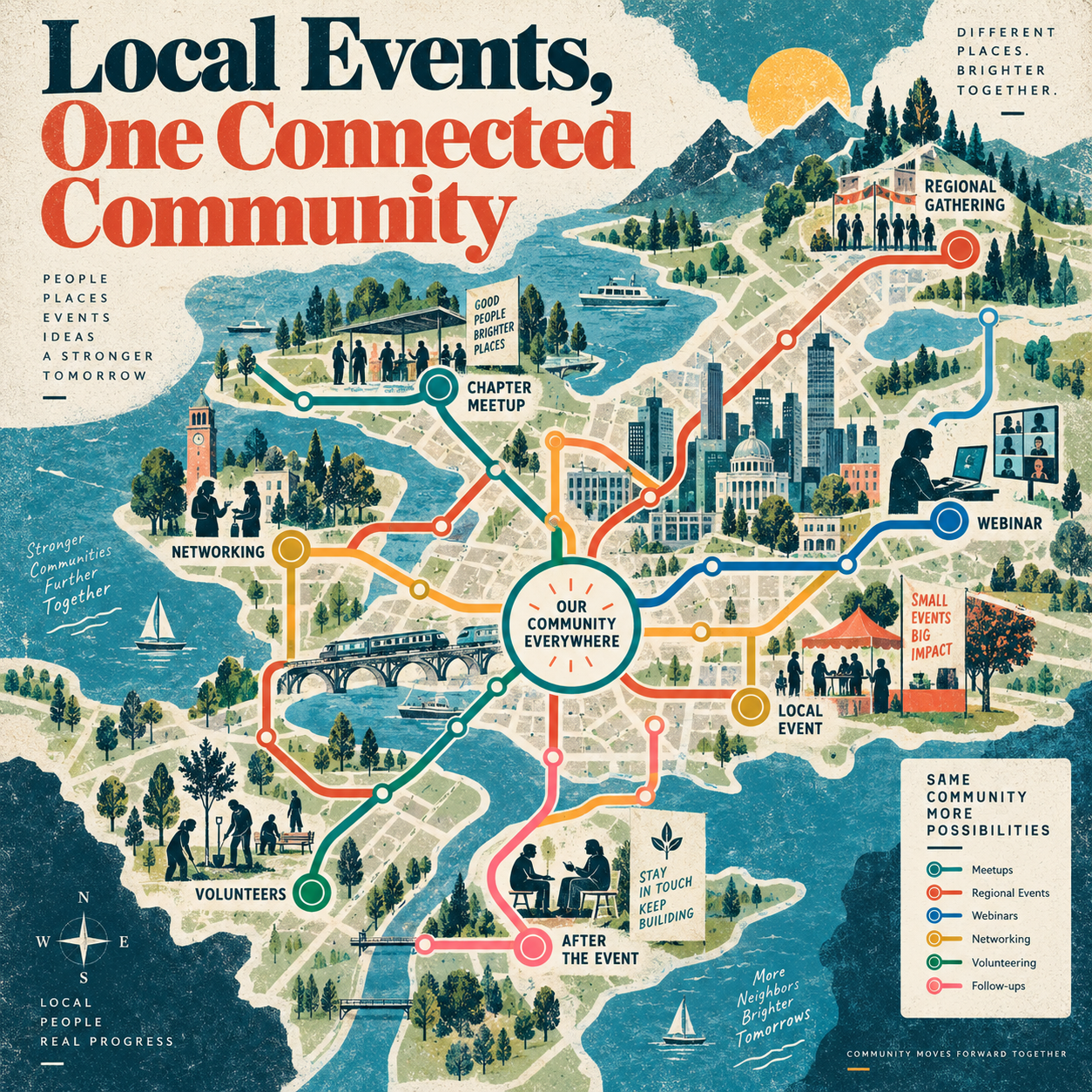
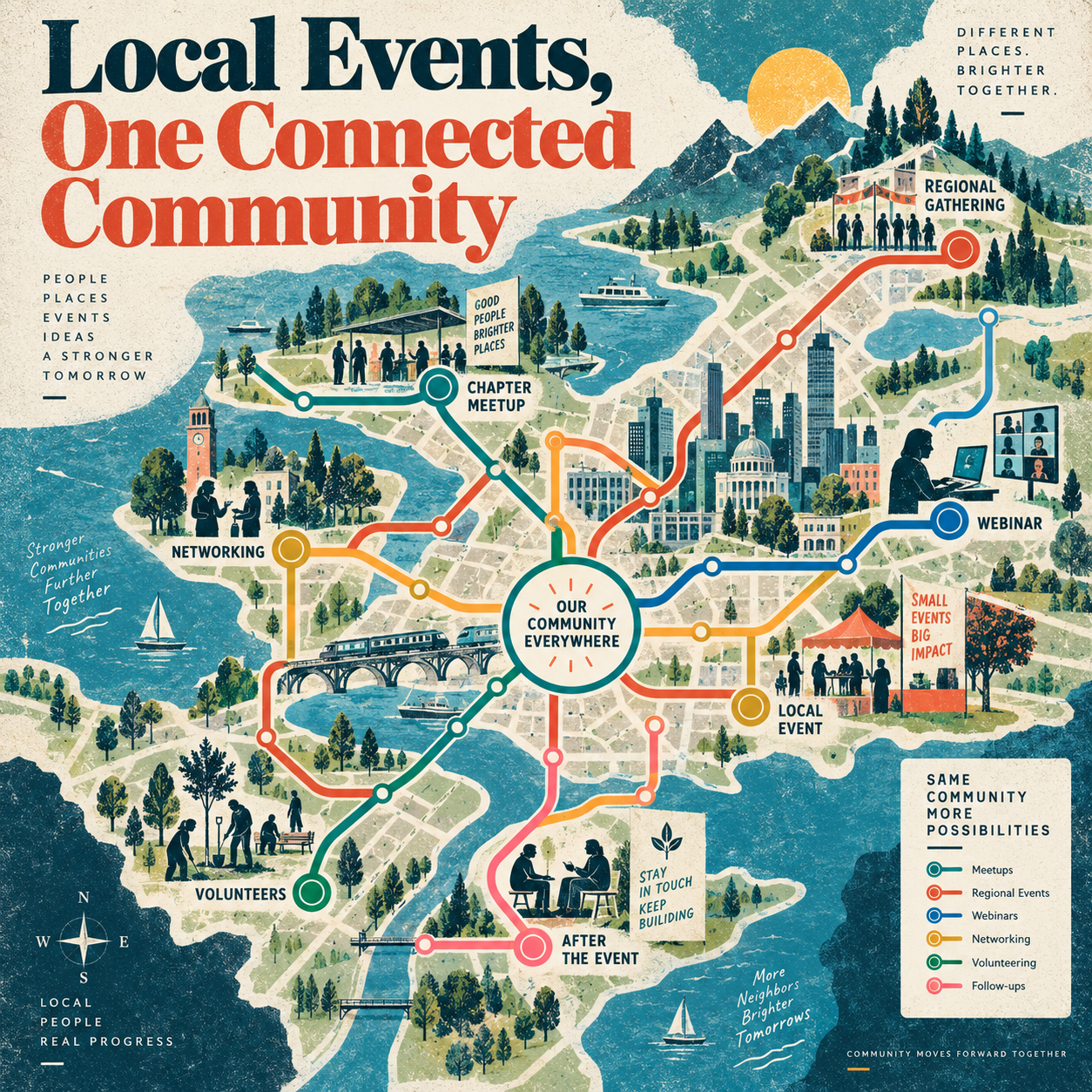
Member-led local events often look simple from the outside. A chapter organiser chooses a venue, sends an invitation, manages RSVPs, runs the event, and follows up afterwards. In practice, the work is rarely that tidy.
Imagine Priya, a regional community manager for a membership organisation with 14 chapter leads across the country. One chapter uses Eventbrite, another manages RSVPs through a Google Form, another shares updates in WhatsApp, and follow-up from several events lives in individual inboxes. Local organisers are committed, members want to gather, and events are happening regularly.
But Priya has a visibility problem. She cannot easily see which activities are gaining momentum, which members are returning, which volunteer roles still need support, or whether someone who attended a regional meetup ever found their way into another part of the community. Chapter organisers are repeating the same setup work, and members often hear about local activity only if they already know the right person.
The issue is not whether the community wants to gather. The issue is that the systems around those gatherings are fragmented.
That is why choosing community event management tools for member-led local events requires a different lens. Registration and reminders still matter, but they are only part of the job. The stronger question is whether the tool can make local events easier to coordinate, easier to discover, more valuable to attend, and easier to connect into the wider community.
Why Local Event Tool Evaluation Is Changing
For years, many event tools were evaluated primarily on logistics. Could organisers create an event page? Collect RSVPs? Send reminders? Manage tickets? Update attendees if the venue changed?
Those functions remain useful, but chapter and regional events create a different operational challenge.
Local events are usually distributed. Different organisers may run activities in different locations, with varying levels of experience, available time, and support from the central team. Some groups may run monthly meetups. Others may organise quarterly events or occasional sponsor-backed activities.
That creates two competing needs.
Local organisers need enough autonomy to run useful events without waiting for central staff to handle every detail. At the same time, the wider organisation needs enough visibility to understand what is happening, where participation is growing, and where local organisers may need support.
The best-fit community event management tool therefore needs to do more than process registrations. It should make distributed participation easier to coordinate without turning every local event into another disconnected workflow.
What Chapter and Regional Organisers Actually Need
The buying question is not simply:
Which tool has the most features?
A better set of questions is:
- Can local organisers create and update events without heavy admin?
- Can members easily discover activity relevant to them?
- Can people see who is involved and where they fit?
- Does the tool help make networking less dependent on chance?
- Can organisers follow up after the event without rebuilding everything manually?
- Can the wider organisation see participation across recurring local events?
- Does the tool complement existing systems instead of becoming another silo?
For members, a useful platform should also make five basic questions easier to answer:
- What is happening?
- Who is involved?
- Where do I fit?
- How can I participate?
- What should I do next?
If a tool makes the event easier to administer but does not make participation easier to understand, it may solve only part of the problem.
8 Criteria for Comparing Community Event Management Tools
1. Can Local Organisers Run Events Without Heavy Admin?
Local organisers are often volunteers, chapter leaders, community managers, or staff with other responsibilities. They should not need to become event software specialists just to run a meetup.
When comparing tools, test how long it takes to create a real event. Then change the venue, update the time, add a host, repeat the event, and prepare follow-up.
Look for:
- reusable event templates
- simple event creation
- easy updates
- clear permissions
- assisted setup where appropriate
- fewer repeated manual steps
For distributed communities, setup burden matters because every extra step is multiplied across multiple organisers and events.
For growing chapter networks, reducing event setup from hours of manual rebuilding to a more assisted, repeatable process can matter just as much as improving engagement features, because both affect how many quality events local leaders can realistically run.
The goal is not simply faster administration. It is giving organisers more capacity to support members, connection, and participation.
2. Does It Support Member-Led Events, Not Only Centrally Managed Ones?
Some platforms work well when one central event team controls everything. That does not necessarily mean they work well when 10, 20, or 50 local organisers are running activities.
A member-led model needs a balance between local autonomy and central visibility.
Local leaders should be able to create and manage their own activities without waiting for head office to make every change. The central team should still be able to maintain appropriate standards, understand what is happening across the network, and support organisers when necessary.
A useful trial question is:
Can a local organiser run this confidently without creating extra clean-up work for the central team?
If the answer is no, the tool may become another coordination bottleneck.
3. Can Members Easily Discover Local Activity?
An event cannot create community value if members do not know it exists.
This is a common problem in distributed organisations. Events may be promoted through chapter emails, social posts, newsletters, private groups, or personal networks. Members who already know the organiser stay informed. Everyone else can easily miss relevant opportunities.
A stronger system should make it easier to discover activities by location, topic, interest, or community.
Members should not need to search through several channels just to answer:
What is happening near me, and is it relevant?
Discoverability becomes particularly important as the number of local activities grows. Better visibility can help organisations increase participation without asking every chapter organiser to promote every event manually.
4. Does It Reduce Social Friction and Improve Networking?
Local events may be smaller than major conferences, but connection often matters even more.
People may attend because they want to meet peers, find others facing similar challenges, reconnect with the community, or build local professional relationships. Yet putting people in the same room does not guarantee those connections happen.
When comparing community event management tools, look beyond attendee lists. Ask whether the experience can help people:
- discover relevant attendees
- identify shared interests
- understand who is part of the local community
- join conversations more easily
- receive useful introductions or prompts
- continue a connection afterwards
For more on this gap, see Why Attendees Leave Events Without Making the Right Connections.
Human support still matters too. Local hosts, ambassadors, and chapter organisers can help people enter conversations and feel part of the event. For more on that layer, see Why Events Need Community Hosts, Not Just Agendas.
The aim is not to automate networking. It is to reduce unnecessary friction around finding and entering useful conversations.
5. Does It Support Post-Event Follow-Through?
Many event tools are strongest before the event and during registration. The experience becomes much weaker once the activity ends.
That is a problem for member-led communities because local events should ideally create another step.
Someone may attend their first chapter meetup, meet several relevant people, ask about volunteering, or show interest in an upcoming topic. If those signals disappear after the event, the community loses an opportunity to build deeper participation.
Look for ways to support:
- timely follow-up
- next-event invitations
- volunteer or host interest
- topic-based follow-on activity
- post-event conversations
- repeat participation
- continued connection between attendees
The event should not become a dead end.
For more on sustaining value between major activities, see Member Engagement Ideas Between Annual Events.
6. Can It Support Recurring Local Events Without Starting From Zero?
Recurring activity is where community value begins to compound.
A chapter might run monthly breakfasts. A regional group may hold quarterly roundtables. A professional community may alternate between local meetups, webinars, and larger annual gatherings.
If every activity requires a complete reset, organisers lose time and the organisation loses community knowledge.
A stronger tool should help carry forward useful context such as:
- repeat attendance
- member interests
- host or volunteer history
- commonly used event formats
- local participation patterns
- previous topics
- next-step activity
This does not mean every event needs to look identical. It means organisers should not have to rebuild the operating layer every time.
For a related perspective on creating momentum before people even arrive, see Great Events Don’t Start Cold.
7. Does It Support Distributed Coordination Without Becoming Confusing?
Member-led events usually involve several groups with different responsibilities, from local organisers and hosts to central community teams and partners.
A useful tool should make those roles clearer rather than mixing everyone into the same workflow.
When comparing options, test:
- organiser permissions
- local versus central visibility
- volunteer or host coordination
- repeat event ownership
- reporting across locations
- event updates and change handling
The goal is not to centralise every action. It is to reduce the amount of coordination that currently depends on email chains, personal memory, and manual checking.
8. Does It Complement Existing Systems Instead of Creating Another Silo?
Most organisations already have systems for membership, email, registration, CRM, websites, surveys, or reporting.
A new community event management tool should not automatically require those systems to be replaced.
The stronger question is whether the tool can create a clearer participation layer around existing activity.
Can local event information become easier to see? Can participation signals be exported or shared? Can the team avoid re-entering the same information repeatedly? Can recurring community activity be understood more clearly across locations?
If the new tool simply creates another isolated database, the organisation may end up with more fragmentation rather than less.
Comparing the Main Types of Community Event Management Tools
There is no single category of software that is best for every local event model. Different tool types solve different parts of the problem.
Understanding those differences is more useful than comparing feature counts alone.
1. Basic Event Planning and Registration Tools
These tools are often useful for:
- event pages
- RSVPs
- ticketing
- reminders
- basic attendee management
They can work well when the main need is straightforward event administration.
The limitation is that they may treat each event primarily as a transaction. They can tell you who registered, but may provide less support for ongoing community participation, member connection, or continuity between events.
For occasional standalone events, that may be enough. For recurring member-led activity, it may leave important gaps.
2. Community Management Software
Community management platforms are usually stronger around ongoing communication, member groups, discussions, and content.
They can work well for communities where conversation is the primary engagement model.
The trade-off is that event coordination may be secondary. Teams may still need separate tools for registration, local organiser workflows, recurring event setup, or event-specific engagement.
This can work, but teams should check whether event activity becomes disconnected from the rest of the community experience.
3. Chapter or Association Management Platforms
These platforms may be well suited to organisations with formal chapters, structured membership records, local leadership, and central oversight.
They can provide useful administrative visibility across a large network.
The question is whether the system is designed primarily to manage records and processes or to help people participate. A platform can be operationally powerful while still leaving networking, event discovery, and community momentum to separate tools or manual effort.
4. Event Engagement Platforms
Event engagement platforms typically go further than registration and logistics. They may support attendee networking, participation, sponsor interaction, profiles, prompts, and broader event experiences.
These can be useful when improving the live event experience is a priority.
For chapter and regional organisers, however, buyers should check whether the platform works equally well for a 40-person recurring meetup as it does for a 1,000-person conference. Some event engagement platforms remain heavily centred on larger event moments.
5. Community-First Event Engagement Platforms
Community-first platforms take a broader view. Instead of treating each event as an isolated transaction, they aim to connect events to ongoing participation.
For member-led local activity, this model may be particularly relevant when the organisation wants to improve:
- local event discoverability
- member connection
- recurring participation
- host and organiser workflows
- visibility across distributed activity
- post-event continuity
The important distinction is not the label itself. It is whether the platform can make community participation easier before, during, and after events without creating more coordination burden.
What to Assess During a Trial or Demo
A product demonstration can make almost any platform look straightforward. The better test is to use a realistic local-event workflow.
Do not only ask the vendor to show features. Ask them to show how your organisers would actually work.
| What to assess | How to assess it | Who it helps | What decision it informs |
|---|---|---|---|
| Setup burden | Build a real local event, change a detail, then repeat the event using the same structure | Chapter organisers and operations teams | Whether the tool is practical for lean local organisers |
| Local event visibility | Test how easily members can discover nearby or relevant activities | Members and community teams | Whether the tool improves event discoverability |
| Networking support | Review attendee discovery, introductions, shared interests, prompts, profiles, and host support | Attendees and event teams | Whether the tool reduces social friction |
| Post-event follow-through | Test follow-up prompts, next-step invitations, volunteer interest and ongoing discussion options | Membership and community teams | Whether events can lead to repeat participation |
| Multi-organiser coordination | Test permissions, chapter workflows, central oversight and local autonomy | Regional and central teams | Whether the tool supports distributed organisers |
| Participation visibility | Review reporting on attendance, repeat participation, interest, volunteer activity and follow-up | Leadership and community teams | Whether the organisation can see what is driving community growth |
| Recurring event continuity | Repeat an existing event and review what information or context carries forward | Chapter and event teams | Whether recurring events become easier over time |
| Existing system fit | Review integrations, exports, imports and compatibility with current processes | Operations and digital teams | Whether the tool reduces or adds fragmentation |
This type of testing reveals something a standard feature demonstration may not: whether the software actually fits the operating model of a distributed community.
Common Mistakes When Comparing Local Event Tools
Mistake 1: Choosing Based on Feature Volume
More features do not automatically mean a better fit. A chapter organiser may get more value from a simple, repeatable workflow than from a complex platform with dozens of functions they will never use.
Evaluate what the tool helps your community accomplish.
Mistake 2: Optimising Only for the Central Team
A system may look manageable to a professional events team but feel heavy to a volunteer chapter lead.
If local organisers will actually run the events, involve them in the evaluation.
Mistake 3: Treating Registration as Community Engagement
Registration proves intent to attend. It does not prove connection, participation, belonging, or repeat involvement.
If the wider goal is community growth, those outcomes need to be part of the comparison.
Mistake 4: Ignoring What Happens After the Event
A platform that performs well until check-in but provides little support afterwards may leave much of the community value unused.
Test the full journey, including the next activity.
Mistake 5: Adding Another Tool Without Reducing Fragmentation
A new platform should remove some coordination burden or create clearer visibility. If the team simply adds it on top of spreadsheets, inboxes, forms, and chat threads without changing the workflow, complexity may increase.
A Simple Decision Framework
The best community event management tool depends on what your local-event model actually needs.
If your main requirement is basic registration and ticketing, a straightforward event planning tool may be enough.
If ongoing online conversation is the priority and events are secondary, community management software may be the better fit.
If you run a highly structured chapter network with complex membership administration, an association or chapter platform may be necessary.
If the challenge is making large events more participatory, an event engagement platform may solve more of the problem.
But if local events are part of a broader member community and the challenge is connecting coordination, discoverability, networking, recurring participation, and post-event momentum, a community-first event engagement approach deserves closer consideration.
The decision should follow the operating problem, not the category label.
Final Thought
The right tools for member-led local events are not necessarily the ones with the longest feature lists. They are the ones that fit how your organisers and members actually participate.
For chapter and regional communities, that means balancing local autonomy with wider visibility. It means making activities easier to discover, reducing repetitive setup, helping members connect, and creating clearer next steps after each event.
The goal is not simply to run more local events.
It is to make each event easier to support and more valuable to the community around it.
Looking for a Better Way to Support Member-Led Local Events?
SixSides helps community-led organisations turn fragmented local event coordination, member participation, and recurring activity into a clearer community experience with better visibility and less manual administration.
If your team is trying to make chapter and regional events easier to run, easier to discover, and more connected before, during, and after each gathering, the Book a demo option on this page is there if you want to see how that could work in practice.
Give your event a community that lasts
A branded app where members show up before day one and stay long after the close. We'll walk you through it.