Blog
Community Scaling: How to Grow Member-Led Event Communities Without Adding More Admin
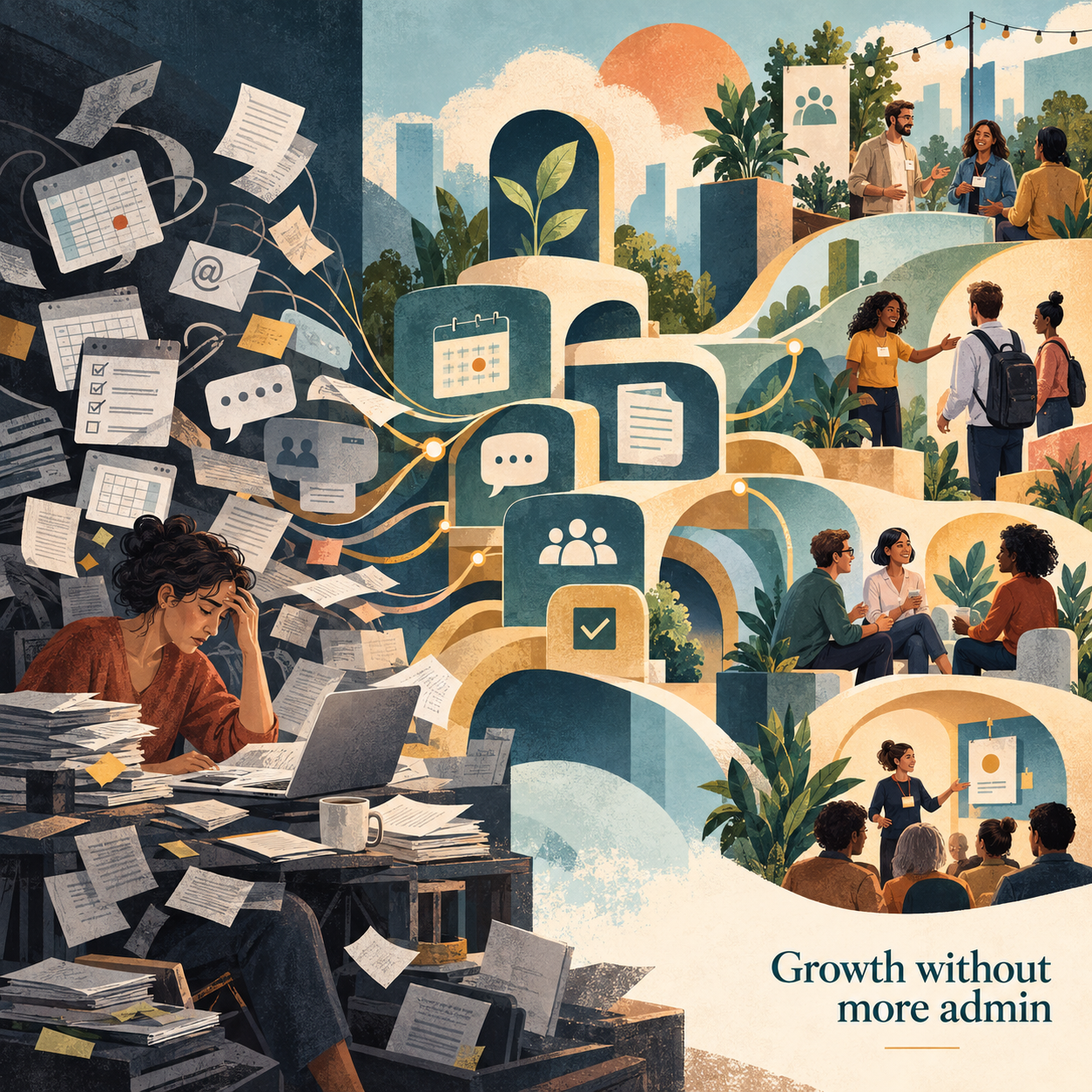
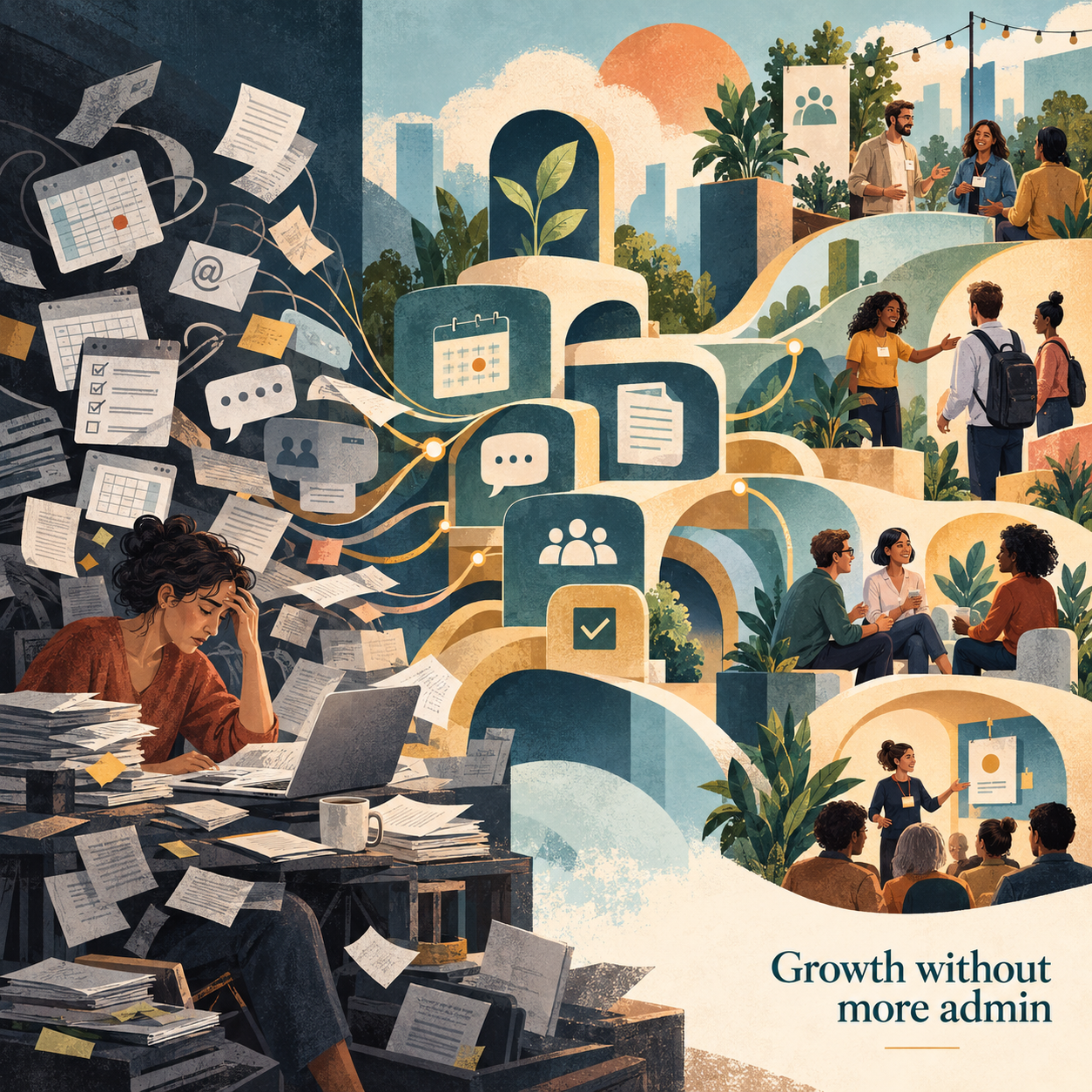
Community scaling sounds simple until the work starts to spread. More members, more local events, more ambassadors, more follow-up, more questions, and more moving parts can quickly turn community growth into community administration.
For member-led event communities, this is especially common. The signs of success can become the source of pressure. Members want to host gatherings, ambassadors want to help, local groups want support, sponsors want visibility, and community managers are expected to keep participation moving across the year.
Imagine Emma, a community manager supporting a growing professional association with 12 local member groups. The annual conference went well, three regional meetups are being planned, five ambassadors have offered to help, and members are asking for more ways to connect between major events. On paper, the community is growing.
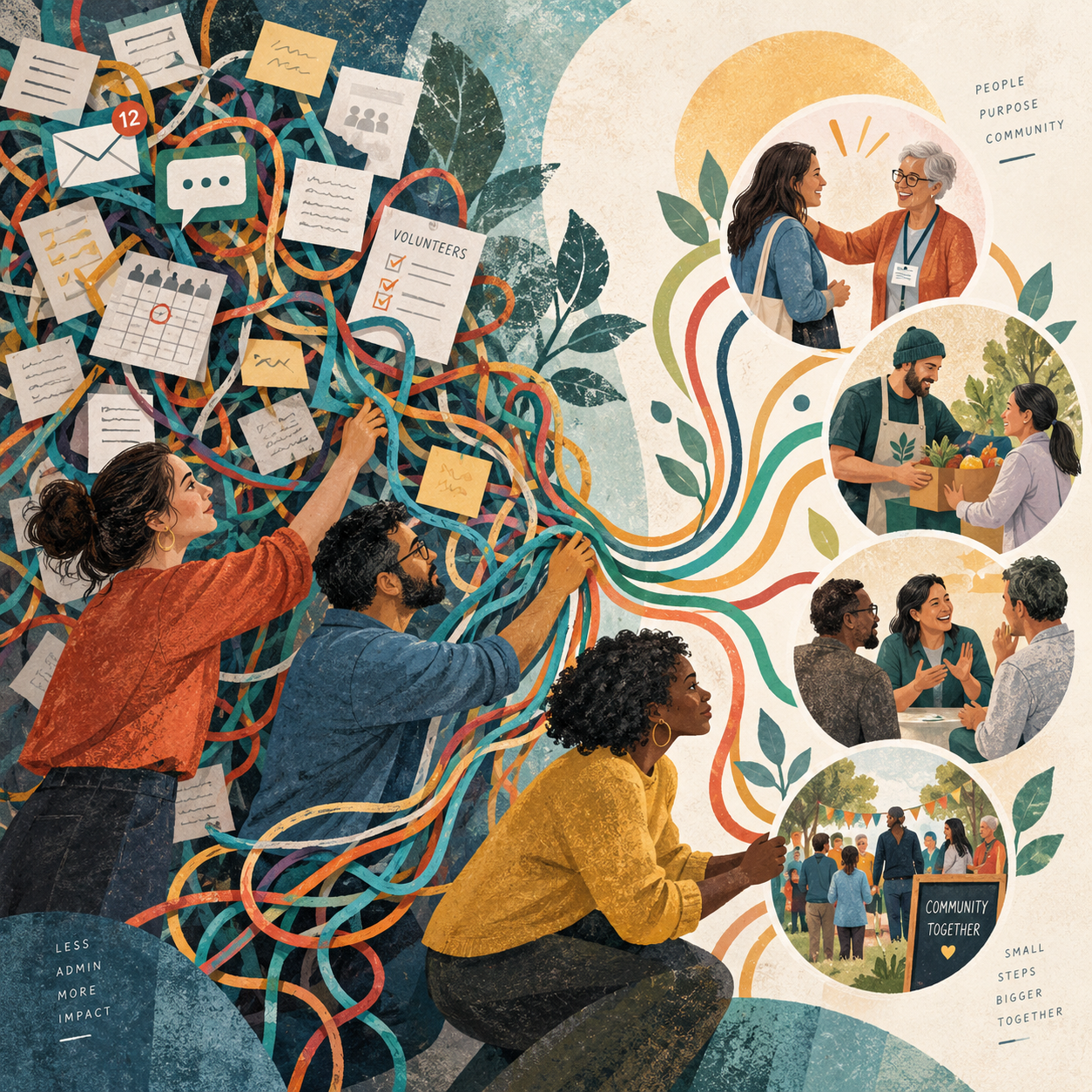
But Emma’s week tells a different story. One ambassador update is buried in Slack. Event details are sitting in a spreadsheet. Follow-up notes are in someone’s inbox. A potential volunteer filled out a form two weeks ago, but no one has invited them into a next step. The interest is there, but the system to support it is starting to strain.
That is the real challenge of community scaling. Most member-led event communities do not struggle because members lack interest. They struggle because participation, follow-up, ambassador activity, and next-step opportunities are spread across inboxes, spreadsheets, chat threads, event tools, and informal staff knowledge.
That makes community growth harder to see, harder to support, and harder to scale.
The stronger question is not simply, “How do we grow the community?” It is, “How do we make participation easier to repeat without adding more manual coordination every time the community grows?”
What Community Scaling Really Means
Community scaling is not just about adding more members, events, posts, or channels. More activity can look like growth, but it can also create more complexity for the team behind it.
In a member-led event community, real community scaling means creating a repeatable system where more people can discover opportunities, join relevant conversations, contribute in small ways, host or support activity, and continue participating after each event.
That distinction matters. A community can be busy without becoming stronger. It can have high attendance but limited contribution. It can have active ambassadors but no clear workflow. It can have member interest but no easy way to turn that interest into participation.
Community scaling should make the community easier to enter, easier to support, and easier to continue. If growth only creates more admin, the model is not scaling. It is stretching.
Why Member-Led Communities Stop Scaling
Many member-led communities reach a point where participation depends too much on a small group of people. The same members host. The same volunteers contribute. The same staff remember what happened last time. The same community manager follows up manually.
That works while the community is small, but it becomes fragile as more events, groups, and members are added.
The common pattern looks like this:
- member interest increases
- more local or community-led activities begin
- ambassadors and volunteers need support
- event setup becomes repetitive
- follow-up becomes inconsistent
- staff rely on spreadsheets, inboxes, and memory
- engagement drops after the event because the next step is unclear
The issue is not always lack of enthusiasm. Often, the community has enough interest. What it lacks is a visible and repeatable participation layer.
For member-led communities, this layer matters because growth cannot depend only on central staff. If every event, introduction, follow-up, and volunteer opportunity needs to be manually coordinated, the community can only grow as fast as the team’s capacity allows.
The Before, During, and After Model for Community Scaling
A practical way to scale a member-led event community is to design participation across three stages: before, during, and after each activity.
Before the Event
Before the event, members need to understand what is happening, who it is for, why it is relevant, and how they can participate. This is where community scaling often begins.
If people arrive cold, the live event has to do too much work. Stronger pre-event engagement helps members see the themes, people, groups, and opportunities connected to the event before they arrive. For more on this, see Great Events Don’t Start Cold.
During the Event
During the event, members need entry points. They need simple ways to join conversations, meet relevant people, contribute to discussions, and understand where they fit.
This is where community hosts, ambassadors, or facilitators can help. They reduce social friction and make participation easier, especially for first-time attendees, quieter members, or people attending alone. For a deeper look at this layer, see Why Events Need Community Hosts, Not Just Agendas.
After the Event
After the event, members need a next step. Without one, momentum fades quickly. People may have joined a useful discussion, met someone relevant, or shown interest in contributing, but if that signal is not captured and acted on, the opportunity can disappear.
This is where event activity becomes community growth. The goal is to turn attendance into repeat participation, contribution, and stronger member relationships over time. For a related perspective, see Member Engagement Ideas Between Annual Events.
10 Practical Ways to Scale a Member-Led Event Community
1. Design for Progression, Not Just Participation
A scalable community does not only ask whether members attended. It asks whether they are progressing.
A member might move from attending one event, to joining a discussion, to returning for another activity, to volunteering, to hosting, to becoming a local leader. If that pathway is invisible, many willing members never take the next step.
A simple progression model could look like:
Attend → Connect → Participate → Return → Contribute → Host → Lead
This gives the community team a clearer way to support growth. Instead of treating every attendee the same, the team can identify who may be ready for a small next step.
2. Make Member-Led Opportunities Easier to Discover
A common scaling problem is that opportunities exist, but members cannot easily find them. Local events may be promoted in one place, volunteer roles in another, ambassador updates somewhere else, and follow-up discussions in a separate channel.
When opportunities are scattered, participation becomes harder than it needs to be.
A stronger model gives members one clearer view of what is happening, where they fit, and what they can do next. This might include local meetups, discussion groups, hosted introductions, volunteer opportunities, chapter activities, topic-based sessions, or post-event follow-ups.
The goal is not simply to organise information. It is to make participation easier to enter.
3. Use Ambassadors as a System, Not an Ad Hoc Volunteer Layer
Ambassadors can be powerful in member-led communities, but only when they are supported by a clear system. Without that, ambassador activity often depends on individual energy, memory, and confidence.
A scalable ambassador model should make it clear what ambassadors are responsible for, which activities they can support, how they are briefed, how they report back, and what signals the community team should capture.
Ambassadors do not need heavy processes. They need simple workflows. For example, they might welcome first-time attendees, introduce people around shared topics, host a local conversation, share approved event prompts, or note where members need follow-up.
That turns ambassadors from informal helpers into a repeatable participation layer.
4. Automate Repetitive Coordination
Community automation should not replace the human layer. It should reduce the repetitive admin that prevents teams from supporting the human layer well.
In member-led event communities, automation can help with reminders, event setup, ambassador prompts, welcome messages, follow-up invitations, contribution pathways, and post-event surveys. The point is not to send more messages. It is to make the right next step easier to trigger.
For example, if a member attends their first local meetup, they could automatically receive a relevant next-step invitation. If someone expresses interest in hosting, the team can trigger a simple ambassador onboarding path. If a topic receives high engagement, the community team can create a follow-up discussion without rebuilding the process from scratch.
As communities grow, reducing repeat event setup from hours to minutes can matter just as much as improving follow-up, because both affect how much capacity the team has to support participation.
Automation works best when it supports participation, not just administration.
5. Create Pre-Event Signals That Guide Connection
Connection becomes easier when members can see relevance before they arrive. If attendees know who else is interested in the same topic, which discussions are forming, or what groups are likely to be present, they are more likely to participate with intention.
This is especially useful for first-time members, new chapters, sponsor-backed gatherings, and larger conferences where the room can feel overwhelming.
Pre-event signals might include topic selection, attendee goals, interest tags, discussion prompts, saved sessions, or opt-ins for introductions. These signals help organisers and hosts understand where connection may be needed.
Without those signals, networking often relies on luck. For more on that gap, see Why Attendees Leave Events Without Making the Right Connections.
6. Give Members Lightweight Ways to Contribute
Community growth becomes harder when contribution feels too large. Not every member is ready to join a committee, speak at an event, or host a local group. But many members may be willing to take a smaller step.
That might include suggesting a topic, welcoming newcomers, joining a discussion, sharing a resource, introducing a peer, answering a member question, or helping with one local activity.
These micro-contributions matter because they widen participation beyond the same small group of active members. They also help members build confidence and identity inside the community.
Scaling contribution is not only about finding more leaders. It is about creating smaller steps that help more people become involved.
7. Turn Event Momentum Into Ongoing Participation
A strong event can create energy, but that energy fades if there is no next step. Member-led communities need a way to turn event-day participation into year-round activity.
After an event, the team should know which topics created interest, who met useful people, who may want to contribute, which ambassadors were active, and which discussions should continue. Those signals can shape follow-up, local events, content, introductions, and future programming.
This is how events become more than isolated moments. They become part of a broader participation journey.
The stronger the post-event pathway, the less the community has to restart from zero each time.
8. Reduce Reliance on the Same Active Few
Many communities are carried by a small number of highly active members. These people are valuable, but over-reliance creates risk. It can lead to burnout, limited diversity of contribution, and a community that looks active while only a small group is truly participating.
Community scaling requires wider contribution. That means identifying members who are showing early signals of interest and giving them low-friction ways to take part.
A member who attends two events in a row might be ready for a small volunteer role. Someone who asks strong questions might be invited into a discussion group. A member who brings others into conversation might be a future host or ambassador.
The aim is not to pressure members into more work. It is to make the next step visible when interest is already present.
9. Use Community Knowledge to Guide Next Actions
As communities grow, staff cannot rely only on memory. They need clearer knowledge about what members care about, where participation is increasing, where friction appears, and who may need support.
Community knowledge can include topic interest, attendance patterns, ambassador activity, connection signals, contribution history, follow-up engagement, and member feedback.
When this information is visible, the team can act more intentionally. They can recommend relevant events, create better introductions, support ambassadors, invite members into the right opportunities, and design future activities around actual participation signals.
This is one of the clearest differences between community management and community growth. Management keeps activity running. Growth uses participation knowledge to help the community develop.
10. Measure Scaling Through Behaviour, Not Just Size
A larger community is not automatically a stronger community. More members, more events, or more registrations may look positive, but they do not prove that participation is deepening.
Better community scaling metrics look at behaviour. Are members returning? Are first-time attendees taking a second step? Are ambassadors active? Are introductions happening? Are more people contributing? Is post-event momentum continuing? Is admin effort reducing as activity grows?
These signals show whether the community is becoming more scalable or simply busier.
What Organisers Should Capture
A useful community scaling model should show what to capture, how to capture it, who it helps, and what decision it should inform.
| What to capture | How to capture it | Who it helps | What decision it informs |
|---|---|---|---|
| Ambassador activity | Ambassador check-ins, host notes, event support logs, local activity updates | Community and event teams | Which ambassadors need support, recognition, or clearer workflows |
| First-time to second-step conversion | Follow-up registrations, newcomer pathway joins, second-event attendance within 30 to 90 days | Membership and community teams | Whether new members are entering the community or dropping off |
| Repeat participation | Event attendance across the calendar, discussion activity, chapter RSVPs, webinar joins | Association and community leaders | Whether engagement is recurring or one-off |
| Member-generated introductions | Meeting bookings, host notes, connection requests, post-event survey responses | Community hosts and event teams | Whether members are helping each other build useful relationships |
| Contribution diversity | Volunteer sign-ups, topic suggestions, speaker interest, micro-contributions, local support | Leadership and volunteer teams | Whether contribution is widening beyond the same active few |
| Post-event continuation | Follow-up discussions, resource engagement, community activity, related event registrations | Community and programme teams | Whether event momentum is turning into ongoing participation |
| Admin effort per activity | Setup time, manual follow-up, repeated questions, reporting turnaround, duplicate data entry | Operations and community teams | Whether growth is reducing or increasing coordination burden |
| Automation coverage | Automated reminders, onboarding paths, ambassador prompts, follow-up workflows, triggered next steps | Community operations teams | Where repetitive coordination can be systemised without losing the human layer |
| Opportunity visibility | Clicks on event pages, volunteer role views, local group activity, topic interest selections | Membership and communications teams | Whether members can easily discover where they fit |
| Participation progression | Movement from attendee to participant, contributor, host, ambassador, or local leader | Leadership and community teams | Whether the community is developing future contributors and leaders |
This table helps organisers move beyond broad community growth metrics. The aim is not only to know whether more activity is happening. It is to understand whether participation is becoming easier to repeat, support, and scale.
How to Use These Signals to Scale Smarter
Collecting community scaling data is only useful if it changes decisions. The goal is not to create more reporting for the sake of it. It is to help teams understand where the community is gaining momentum and where growth is creating friction.
If ambassador activity is inconsistent, the issue may be unclear workflows rather than lack of commitment. If first-time to second-step conversion is low, the community may need a clearer newcomer pathway. If repeat participation is strong but contribution diversity is weak, the team may need smaller, more visible ways for members to help.
If admin effort per activity increases every time the community grows, the model is not scaling properly. That may point to manual setup, scattered information, unclear ownership, or disconnected tools.
Better participation visibility also reduces the need for staff to act as the manual coordination layer across inboxes, spreadsheets, chat threads, and one-off follow-up processes.
This is where community automation and community knowledge work together. Automation reduces repetitive coordination. Community knowledge helps teams decide which human moments matter most.
Common Community Scaling Mistakes
Even strong member-led communities can run into scaling problems when growth is approached in the wrong way.
Mistake 1: Measuring Size Instead of Participation
More members or more events may look like growth, but they do not show whether the community is becoming stronger. A better question is whether people are returning, connecting, contributing, and moving into deeper participation over time.
Mistake 2: Treating Ambassadors as a Loose Volunteer Group
Ambassadors need clarity, not bureaucracy. Without a simple system, their contribution becomes inconsistent and difficult to support.
Mistake 3: Adding More Channels Without Improving Visibility
More channels can create more noise. If members still cannot see what is relevant, adding another group, newsletter, or chat space may make participation harder.
Mistake 4: Automating Communication Without Designing the Journey
Automation is useful when it supports the right next step. It is less useful when it simply sends more generic reminders.
Mistake 5: Leaving Post-Event Momentum to Chance
If there is no clear follow-up pathway, event energy fades quickly. A scalable community needs a way to turn event moments into ongoing participation.
Final Thought
Community scaling is not about doing more of everything. It is about making participation easier to repeat.
For member-led event communities, that means designing clear pathways before, during, and after events. It means supporting ambassadors as part of a system, not relying only on individual effort. It means using automation to reduce repetitive coordination while keeping the human layer visible and useful.
The strongest communities do not scale by asking staff to carry more admin. They scale by making opportunities clearer, participation easier, contribution more accessible, and community knowledge more visible.
Growth should not make the community harder to manage. It should make participation easier to sustain.
Looking to Scale a Member-Led Event Community Without Adding More Admin?
SixSides helps community-led organisations turn fragmented participation, ambassador activity, and follow-up into clearer workflows, stronger visibility, and more measurable community growth.
For teams trying to scale a member-led event community without adding unnecessary coordination burden, the Book a demo option on this page is there if you want to see how that could work in practice.
Give your event a community that lasts
A branded app where members show up before day one and stay long after the close. We'll walk you through it.