Blog
Your Members Should Not Feel Like Guests at Their Own Event


Many membership organisations run events for their members.
That sounds obvious, but it raises a more important question: do those events actually make members feel like they belong there?
Imagine a long-time member arriving at an annual conference. They check in, collect their badge, attend the opening session, listen to useful speakers, and recognise a few familiar names on the programme. The event is polished and professionally run.
But by the end of the day, they have mostly sat, listened, and moved through the agenda. They have not contributed to a discussion. They have not met anyone new. They have not felt more visible in the organisation. They attended the event, but they did not feel like they were part of it.
That is the gap.
A member event should not just deliver a programme to members. It should help members feel like active participants in the community the event is meant to strengthen.
If members leave feeling present but not involved, part of the event’s purpose has been missed.
A Member Event Should Feel Like a Community Moment
For associations, professional bodies, and membership organisations, events are rarely just operational activities.
They are moments where the organisation’s community becomes visible.
Members do not only come for content. They come to learn, meet peers, strengthen relationships, recognise familiar faces, discover new connections, and feel part of something that exists beyond the event itself.
That is what makes membership events different from general public events.
If the experience is built mainly around schedules, speakers, and logistics, members may attend without fully participating. They may consume the event, but not feel embedded in it. They may walk away informed, but not more connected.
The event may have worked at the surface level, while underperforming as a membership value moment.
Why Members Can Still Feel Like Guests
This usually does not happen because organisers are doing a poor job.
It happens because many events are still structured around delivery rather than participation.
A lot of effort goes into making the day run smoothly. That work matters. Registration, agenda design, speaker coordination, venue planning, sponsor management, and communications all play an important role.
But when operational needs dominate the event design, members can become passive recipients of the experience rather than active contributors to it.
They arrive, sit in sessions, move through the programme, perhaps talk to one or two people they already know, and then leave.
They may never really feel invited into the wider community dynamic of the event.
That is why some membership events feel polished but flat.
The logistics work, but the sense of ownership does not.
Attendance Is Not the Same as Participation
Attendance tells you that members were present.
Participation tells you that members were involved.
Those are not the same thing.
A member can attend every session, stay for the full day, and still not feel like they meaningfully took part in the community around the event.
They may not meet anyone new. They may not contribute to discussion. They may not feel visible. They may not feel more connected afterwards than they did before they arrived.
For membership organisations, that matters.
The event should be doing more than filling seats. It should help turn membership into something members can actually experience, not just something they pay for.
Member Value Becomes More Visible at Events
Events are one of the clearest places where membership value can either become real or fall flat.
Members often judge the organisation through what happens at its events.
Do they feel welcomed? Do they find relevant conversations? Do they feel that the organisation understands what they need? Do they feel part of a professional community, or just part of an audience?
These are not small details.
They shape how members experience the organisation itself.
A strong member event helps people feel that membership means access to a real community, not just access to content. It gives them a stronger sense of identity, relevance, and belonging.
That is why member participation is not a nice-to-have.
It is part of the wider membership proposition.
What Stronger Member Participation Looks Like
A stronger member event does not need to become over-engineered or overly formal.
It simply needs to be designed with more intention around participation.
That might mean helping members understand who is in the room and why they matter. It might mean making it easier to connect around shared interests, challenges, sectors, or goals.
It might mean creating more space for contribution, discussion, recognition, and follow-up rather than relying only on passive content consumption.
For example, instead of treating a networking break as open time, organisers could create a short prompt around a shared member challenge:
“Find someone working on a similar issue and compare what has changed for your organisation over the past year.”
That kind of prompt does not force interaction. It gives members a practical reason to speak, contribute, and recognise shared experience.
The important point is that members should feel like they are part of the event, not just attending it.
The value is not in adding more noise.
It is in helping the event become more connected, more participatory, and more meaningful for the community it is meant to serve.
A Simple Member Participation Checklist
A member event is more likely to feel participatory when the organiser can answer these questions:
- Have members been given a reason to engage before they arrive?
- Can members identify people or groups that are relevant to them?
- Are there natural ways for members to contribute during the event?
- Are quieter or newer members given easier entry points into conversation?
- Are returning members encouraged to include others, not just reconnect with familiar groups?
- Are sponsor and partner moments connected to member needs, not treated as separate from the experience?
- Is there a clear way for conversations to continue after the event?
This kind of checklist helps shift the event from delivery to involvement.
It also gives organisers a practical way to assess whether the event is helping members experience the community, not just observe it.
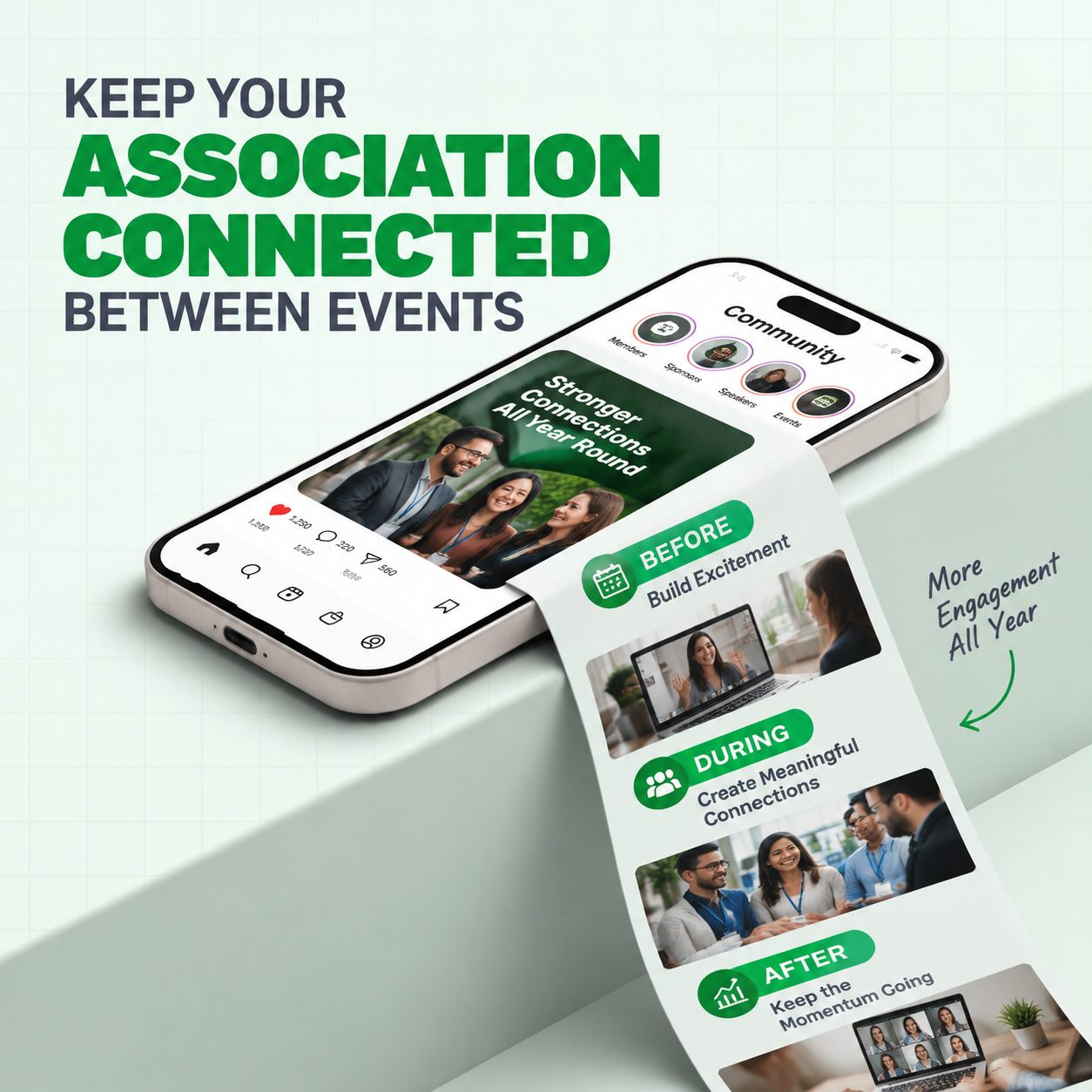
Why This Matters Before, During, and After the Event
Member belonging is not created in a single moment.
Before the event, members need enough context to feel that the experience is relevant to them and that there is a reason to participate, not just show up.
During the event, they need clearer pathways into connection, discussion, and involvement.
After the event, they need some form of continuation so the event does not feel like an isolated occurrence that fades the next day.
This before, during, and after view matters because membership is not a one-day experience.
The event should support the longer arc of community participation and member engagement.
What Organisers Should Capture
If associations want to build stronger member events, they need to measure more than registrations, session attendance, and speaker feedback.
Those numbers still matter, but they do not show whether members felt involved.
A more useful approach is to capture signals that show whether the event strengthened member participation.
| What to capture | How to capture it | Who it helps |
|---|---|---|
| Member connection | Post-event questions such as “Did you meet someone relevant to your role or goals?” | Membership teams understand whether the event strengthened peer relationships |
| Member contribution | Discussion participation, Q&A activity, table prompts, or community posts | Organisers see whether members contributed, not just consumed |
| Sense of belonging | Pulse survey questions such as “Did this event make you feel more connected to the organisation?” | Association leaders understand whether the event supported the membership proposition |
| New or quieter member involvement | First-time attendee activity, newcomer participation, or opt-in follow-up | Event teams identify whether the experience included people beyond existing circles |
| Follow-up momentum | Continued discussion, post-event group activity, repeat attendance interest, or future event sign-ups | Community teams see whether the event created value beyond the day itself |
| Sponsor or partner relevance | Member feedback on whether sponsor or partner conversations felt useful | Commercial teams improve sponsor value without making the event feel sales-led |
This kind of reporting gives a clearer picture of member-event value.
Instead of only saying how many people attended, organisers can show whether members connected, contributed, felt more involved, and had a reason to stay engaged afterwards.
That is a stronger signal of whether the event served the membership community.
Final Thought
Your members should not feel like guests at their own event.
If the event is for them, it should help them participate, connect, contribute, and feel more embedded in the wider organisation and community.
That is when a member event becomes more than a programme.
It becomes a stronger expression of membership itself.
Looking to Create More Meaningful Member Participation at Your Events?
SixSides helps event organisers create stronger attendee participation, better networking, clearer stakeholder value, and more valuable event communities before, during, and after the event.
Book a call with the SixSides team to see how community-led event engagement can improve member participation, networking, and long-term event outcomes.
Give your event a community that lasts
A branded app where members show up before day one and stay long after the close. We'll walk you through it.
.png&w=800&q=75)