Blog
What Associations Should Measure Between Annual Events to Improve Member Retention


Ninety days after her association's annual conference, Membership Director Claire still has plenty of event data. She knows who attended. She knows which sessions filled up. She has satisfaction scores, email opens and registration numbers.
What she cannot easily answer is what happened to those members after the event. Did first-time attendees come back for anything? Did members continue the conversations they started? Which topics kept people involved? Who moved from attending to contributing? And which members quietly disappeared again?
Those questions matter because association member engagement is a pattern that develops across the year rather than a single event outcome. Annual events can create a significant moment of attention and participation, but the months between them show whether that momentum found somewhere to go. The challenge is knowing what to measure.
There Is No Single Metric That Predicts Member Retention
It is tempting to look for one number that tells you which members will renew. In practice, associations should be careful with that assumption. A webinar registration does not guarantee renewal. Opening every newsletter does not necessarily mean someone feels connected. Volunteering does not automatically mean a member will stay. Different associations create value in different ways, and their members behave differently.
The better approach is to identify a small number of meaningful engagement signals, then compare those patterns with actual renewal outcomes over time. That gives the organisation a more grounded question: which behaviours tend to appear among members who stay involved with our association? Here are eight places to start.
1. Repeat Participation After the Annual Event
The first signal is simple: do members come back for anything? That might include webinars, chapter events, roundtables, networking sessions, member forums, working groups, education sessions or smaller community activities. A member who attends the flagship conference and has no further contact for eleven months has a different participation pattern from someone who returns for two or three relevant activities. That difference is worth understanding.
What to measure: the percentage of annual-event attendees who join another activity, the time between the annual event and their next participation, the number of repeat activities across the year, and differences between new and established members.
How to use it: if large numbers of attendees disappear after the annual event, ask whether the next step is visible enough. Do people know what they can join next? Are follow-up activities connected to what interested them at the conference? Or does the association simply return to general communication? For more practical ideas, see Member Engagement Ideas Between Annual Events.
2. Whether Event Connections Continue
Many associations invest heavily in networking, but measuring whether networking happened during the conference is only part of the picture. The stronger question is whether any of those relationships continued. That could mean reconnecting with someone met at the event, joining a follow-up discussion together, attending another activity, continuing a topic conversation, participating in the same chapter or member group, or requesting another introduction.
What to measure: follow-up intent, opt-in reconnection activity, participation in post-event discussions, member feedback about useful connections, and continued involvement in shared topic groups. You do not need to track every private relationship. A few appropriate signals can help show whether the event created connections with somewhere to go next.
3. First-Time Member and Attendee Participation
Overall participation numbers can hide an important problem. The same highly engaged group may be responsible for a large share of activity, while new or less-connected members attend once and remain on the edges. That makes first-time participation worth measuring separately.
Look for signals such as joining another event after the annual conference, participating in a smaller discussion, responding to a member prompt, making a first contribution, joining a chapter activity, accepting an introduction, or returning to another community touchpoint.
The objective is to understand whether new members are finding clear ways to move from being present to having a place in the community, without forcing them into immediate involvement. For more on this journey, see How Events Can Turn First-Time Attendees Into Active Community Participants.
4. Continued Interest Around Particular Topics
Associations often organise their reporting around formats. How many attended the webinar? How many came to the chapter event? How many opened the newsletter? Another useful lens is topic continuity.
Imagine a member who attends an annual-conference session on workforce shortages, joins a related webinar six weeks later, contributes to a chapter discussion, downloads a relevant resource, and joins a working-group conversation on the same issue. The formats changed. The underlying interest did not. That tells the association something useful about relevance.
What to measure: repeated participation around the same theme, topic-specific questions, follow-up discussion, resource engagement, registrations for related activities, and contributions around recurring challenges.
How to use it: strong topic continuity can help programme teams decide which issues deserve more attention, what follow-up activities to create, which communities of interest may be useful, and what should appear in future event programmes. The annual event becomes a source of community insight rather than an isolated programme.
5. Contribution, Not Just Consumption
A member can consume association content for years without becoming visibly involved. That does not mean passive engagement has no value, but contribution gives the organisation another useful signal.
Contribution could begin with something small: asking a question, sharing an example, responding to another member, recommending a resource, making an introduction, or joining a discussion. Later, some members may choose to volunteer, support a chapter, join a committee, mentor another member, speak at an event or host a discussion. These are very different levels of involvement, and they should not be treated as interchangeable.
What to measure: movement along the path from attending to participating to contributing, rather than counting only the final leadership roles. That can reveal whether the association is creating accessible pathways into deeper involvement.
6. Whether Year-Round Communication Leads to Action
Newsletter open rates are useful communication metrics. They are not the same as community participation. For year-round communication, a better question is what the member did because the communication was useful: register for something, respond to a question, join a discussion, discover another member, access a relevant resource, contribute an idea, or re-engage after inactivity.
Good communication should help people understand what is happening, what is relevant to them, where they might fit, how they can participate, and what to do next.
What to measure: clicks into meaningful opportunities, registrations generated, responses to prompts, re-engagement activity, contribution following communication, and differences between member segments. If communication repeatedly creates awareness but little action, the association may need to examine relevance, segmentation or the clarity of the next step.
7. Movement Into Deeper Community Roles
Not every member wants to become a committee chair, and they should not have to. Some members, though, gradually take on roles that create a stronger place for them inside the community. That might look like:
Attendee → Regular participant → Contributor → Volunteer → Host or leader
The path will differ by member. The useful signal is movement.
What to measure: depending on the association, that could include repeat contribution, volunteer interest, chapter involvement, mentoring, committee participation, hosting activity, speaker participation and peer support. This also helps associations see whether opportunities are continually going to the same visible members or whether newer participants are finding pathways to contribute.
8. Early Signs of Reduced Participation
Measurement should not focus only on the most active members. Sometimes the more useful signal is what stops happening. Examples might include a member who attended the annual event but nothing afterwards, previously joined chapter activities but has stopped, used to contribute to discussions but no longer does, stopped responding to invitations that were previously relevant, or joined recently but never found a second participation point.
None of those behaviours proves that someone will not renew, but they can identify patterns worth investigating.
What to measure: extended inactivity, declining participation, lost contribution, reduced response to relevant invitations, and first-year members with no follow-on activity.
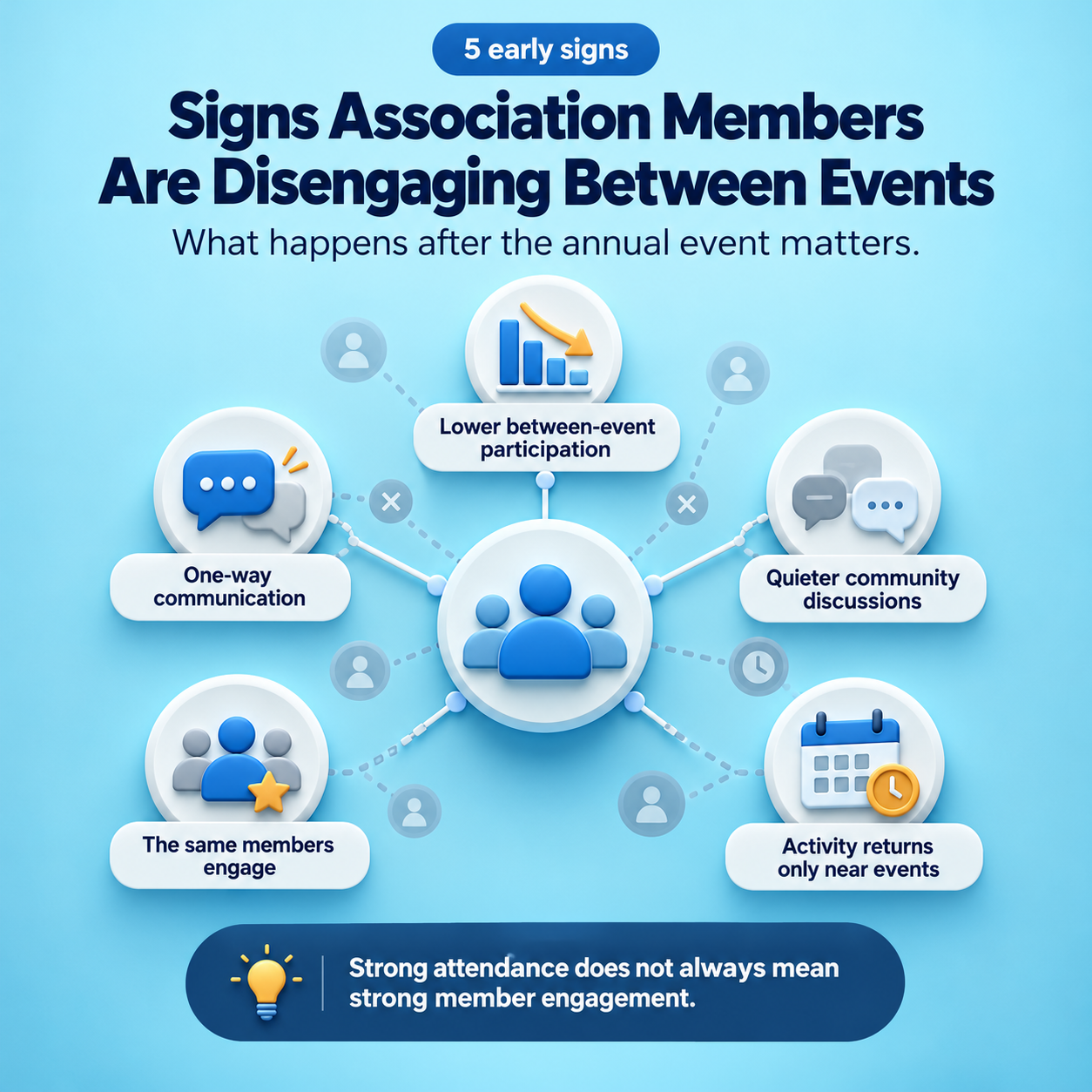
How to use it: the response should not automatically be more reminders. Sometimes a more relevant invitation, personal check-in or easier participation opportunity is more appropriate. For the warning signs to watch for, see Signs Association Members Are Disengaging Between Events.
A Simple Framework: Return, Relationship, Participation, Progression
Association leaders do not need dozens of disconnected engagement metrics. A simpler way to organise them is around four questions.
- Return. Is the member coming back? Look at repeat activities, follow-up registrations and continued involvement.
- Relationship. Is the member becoming connected to other people in the community? Look at useful introductions, continued conversations and peer participation.
- Participation. Is the member doing more than receiving information? Look at discussions, questions, responses and contributions.
- Progression. Is their role in the community changing over time? Look at movement towards repeat participation, contribution, volunteering, hosting or leadership where appropriate.
This turns association community engagement from a vague idea into observable behaviour.
How to Find Which Signals Actually Relate to Retention
This is where associations can move from assumption to evidence.
- Start with actual renewal outcomes. Create cohorts of members who renewed and members who did not. Then look backwards at their participation patterns.
- Compare a small set of signals. For example, repeat-event participation, useful connections, topic activity, contribution, communication response and inactivity. Do not begin with every available data point. Start with signals that reflect meaningful member behaviour.
- Look for patterns, not guarantees. You may discover that members who participate in smaller activities are more likely to renew in your association. Or perhaps chapter involvement matters more. Maybe first-time attendees who make at least one useful peer connection behave differently from those who do not. Those become association-specific retention indicators worth testing further.
- Use the signals to improve the experience. The aim is to identify where people may need a clearer next step, a more relevant opportunity, an introduction, another way to contribute, or better follow-up. Measurement should improve the community experience rather than simply classify members.
A Practical Measurement View
| Signal | What to capture | What it may reveal | Possible action |
|---|---|---|---|
| Repeat participation | Follow-on events or activities | Whether members are returning | Improve post-event next steps |
| Connection continuation | Follow-up or peer activity | Whether relationships have momentum | Create easier reconnection pathways |
| First-time attendee activity | Next participation point | Whether newcomers are finding entry points | Improve newcomer pathways |
| Topic continuity | Repeated theme engagement | What remains relevant over time | Build follow-up programming |
| Contribution | Questions, resources, volunteering | Movement beyond passive consumption | Create lower-friction ways to contribute |
| Communication response | Actions after communication | Whether messages lead somewhere useful | Improve relevance and segmentation |
| Role progression | Member involvement over time | Whether deeper participation pathways exist | Create clearer contribution opportunities |
| Reduced activity | Drop-off or inactivity | Where disengagement may be developing | Use targeted, appropriate re-engagement |
The final column matters. If the association collects a signal but has no idea what decision it should inform, the metric may not be particularly useful.
How to Use These Signals Between Annual Events
Measurement is only worthwhile when it changes what happens next.
Build follow-up around member context. Do not assume everyone leaving the annual event needs the same email sequence. Where appropriate, use what members showed interest in to guide them towards topic discussions, chapter events, peer groups, future sessions, contribution opportunities or newcomer activities.
Create smaller entry points. Not everyone is ready for a committee or volunteer role. Smaller actions such as discussions, introductions and topic-based activities can give people an easier way to participate.
Carry high-interest topics forward. When an annual-event subject generates strong questions or participation, do not automatically wait twelve months to revisit it. Use that signal to inform the year-round community programme.
Review the year before designing the next flagship event. Before planning the next annual conference, ask which members returned, which topics continued, where newcomers stayed involved, where participation fell away, and which activities led to deeper contribution. That creates stronger event engagement strategies because the annual event is informed by the community activity that happened between events.
Common Measurement Mistakes
Treating attendance as retention evidence. Attendance tells you that someone came. It does not tell you whether they stayed involved.
Calling every interaction "engagement". An email open, peer introduction and volunteer role represent very different behaviours. Keep the context.
Looking only at highly active members. Healthy overall activity can hide poor participation among newcomers or less-connected groups.
Claiming a signal predicts renewal without testing it. What matters in one association may be less important in another. Compare engagement patterns with your own renewal data.
Collecting data without a decision attached. Every useful signal should help the team decide what to continue, improve or investigate.
Rebuilding momentum every year. If the community goes quiet after the flagship event, the next annual event has to start from zero again. Year-round participation gives the next event something to build on.
Retention Shows Up Between Events
Annual events matter. They can bring a large part of an association's community together at the same time and create conversations, learning and participation that are difficult to reproduce elsewhere. Member retention, though, is not visible in attendance data alone.
The months between annual events give associations another view. Who returned? Who formed useful relationships? Who participated again? Who began contributing? Who quietly drifted away? And which of those behaviours actually show a relationship with renewal in your own membership data? Those are more useful questions than trying to find one universal engagement metric, because the aim is to understand what helps members find continued value and a meaningful place in the community.
Looking to Strengthen Association Member Engagement Between Events?
SixSides helps associations create clearer pathways for participation, connection and ongoing community momentum before, during and after events. If your team wants to understand and strengthen year-round member participation rather than rebuilding engagement around one annual event, book a demo.
Give your event a community that lasts
A branded app where members show up before day one and stay long after the close. We'll walk you through it.