Blog
The Complete Guide to Association Member Engagement
For many associations, member engagement looks strongest in the lead-up to a major event. Registrations climb, inboxes stay busy, members start paying attention again, and the annual conference or flagship summit creates a visible sense of momentum. The harder question is what happens once that momentum begins to fade.
Too often, the event carries too much of the membership value on its own. Members attend, learn something useful, meet a few relevant people, and leave feeling positive. Then the follow-up becomes generic, the next opportunities are harder to see, and the energy fades until the next major gathering.
Imagine Priya, a mid-career policy professional attending her association’s 800-person annual congress. She joins two sessions on regulatory reform, meets several useful peers, and leaves feeling more positive about membership than she has in months. Two weeks later, she receives a standard thank-you email. Six weeks later, there is no clear invitation to the policy working group that matches her interests, no visible next step, and no easy way to continue the conversations she started.
That is the member engagement problem many associations are really dealing with. It is not always a lack of activity. It is that opportunities, signals, and next steps are often spread across email, chapter pages, spreadsheets, event tools, and disconnected systems, making participation harder to see and harder to support.
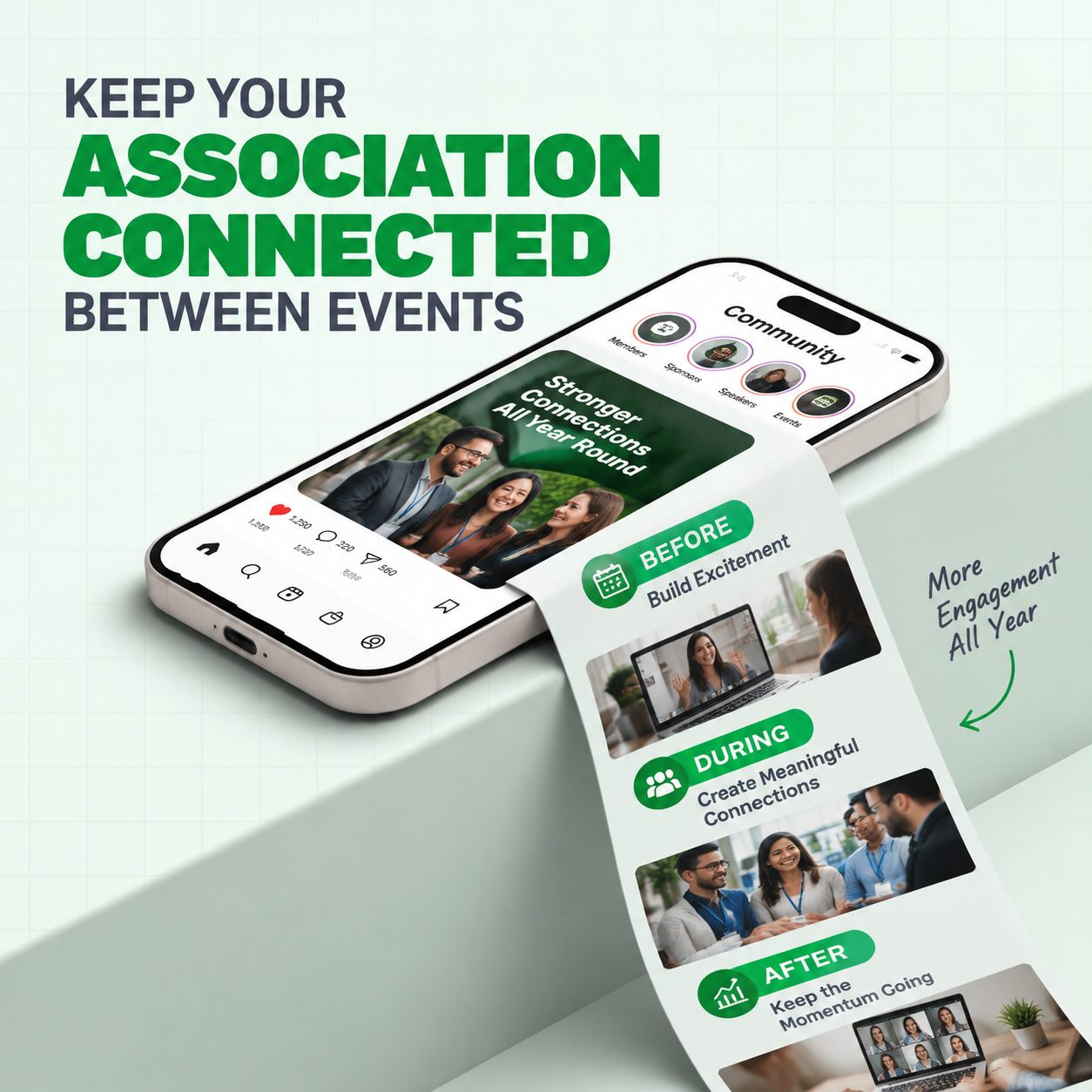
The strongest associations do not treat member engagement as a campaign that peaks around one event. They build it as an ongoing participation journey across the year. Before an event, members need context and reasons to engage. During the event, they need relevant ways to connect and participate. After the event, they need clear pathways to continue.
This guide explains how to build that kind of association member engagement system in practice.
What Association Member Engagement Really Means
Member engagement is often discussed as if it were mainly a communications problem. If attendance is down or renewal confidence feels weak, the instinct is often to send more emails, promote the next event harder, or increase content output. That may create more activity, but it does not always create stronger participation.
Strong association member engagement is not just about message frequency. It is about whether members can see relevant opportunities, understand where they fit, participate without unnecessary friction, and keep moving from attendance into contribution over time.
A practical definition is this:
Member engagement is the extent to which members can discover, join, and continue meaningful participation in the life of the association.
That participation may include attending events, joining discussions, connecting with peers, contributing to committees or working groups, volunteering, engaging with sponsors or partners where relevant, returning for future activities, and stepping into leadership over time.
This matters because member retention usually does not improve through awareness alone. It improves when members repeatedly experience relevance, connection, and progress.
Why Many Associations Struggle With Year-Round Engagement
Most associations are not short on effort. They are short on connected visibility.
The usual pattern looks familiar. A major event creates a spike in energy. Members attend, but do not always know what to do next. Follow-up is broad rather than behaviour-based. Smaller touchpoints exist, but they are not always easy to discover. Chapter, committee, content, and event activity sit across multiple channels.
Staff then become the manual coordination layer. They answer repeated questions, connect people informally, remember who showed interest in what, and try to keep momentum alive through inboxes, spreadsheets, and personal knowledge.
That creates a fragile engagement model. It relies heavily on major event moments, established member habits, and individual staff effort. That may work for a time, but it becomes harder to scale as the community grows.
The deeper shift is this: associations need to move from isolated events to ongoing participation, from fragmented information to clearer community knowledge, and from attendance as an endpoint to participation as a progression.
The Member Engagement Journey: Before, During, and After Events
A useful way to structure member engagement is to treat it as a connected journey rather than a series of unrelated campaigns.
Before the Event
Before an event, members are deciding whether the activity feels relevant enough to prioritise. They want to know what is happening, who will be there, what topics matter, whether there is a place for them, and how to prepare to participate.
When this stage is weak, members arrive cold or skip the event entirely. They may have the logistics, but not enough context to understand why the event matters to them.
During the Event
During the event, members are trying to turn attendance into value. They are looking for relevant sessions, useful peers, easy ways to join conversations, and signals about where they fit.
When this stage is weak, the event may be well run but still feel passive. Members may attend sessions and move through the programme without building the relationships or next steps that make the experience valuable.
After the Event
After the event, the key question is whether the experience turns into another step in the community. Members need useful follow-up, ways to continue conversations, invitations linked to their interests, and visible routes into contribution.
When this stage is weak, event momentum disappears and staff have to rebuild attention from scratch. For a related perspective on sustaining participation after big moments, see Member Engagement Ideas Between Annual Events.
10 Practical Ways to Improve Association Member Engagement
1. Treat Major Events as the Start of Engagement, Not the Finish
Many associations still operate as if the conference is the main event and everything after it is admin. A stronger model treats the event as a launch point for further participation.
The better question is not only, “How many members attended?” It is, “What should happen next for members who showed interest, built useful connections, or engaged deeply?”
That shift changes the purpose of follow-up. The event stops being a one-off success metric and becomes a source of engagement signals for the rest of the year.
Practical moves include:
- grouping attendees by topic, chapter, role, or career stage
- sending follow-up based on what they attended or engaged with
- inviting members into another relevant activity within 7 to 14 days
- creating visible routes from attendee to repeat participant, volunteer, contributor, or local leader
This helps the association get more value from the event investment and gives members a clearer reason to stay involved after the event closes.
2. Make Relevance Visible Before the Event
Pre-event engagement is often too operational. Members receive dates, times, venue details, and logistics, but limited help understanding what will be relevant to them.
That is a missed opportunity. If members arrive without context, event day has to do too much work.
A better approach helps members see which themes are shaping the event, which sessions may matter to their role or challenges, which peer groups are likely to be present, what conversations are already forming, and how they can participate rather than simply attend.
This reduces social friction and helps more people arrive with intention. It is particularly valuable for first-time attendees and quieter participants. For a related perspective, see Great Events Don’t Start Cold.
3. Create Smaller Touchpoints Between Annual Events
Not every member can wait 12 months for their next meaningful interaction. Smaller touchpoints keep the association present and useful without requiring the cost or complexity of a flagship event.
These might include:
- local meetups
- short virtual briefings
- roundtables
- member-only Q&A sessions
- peer discussion groups
- committee previews
- special interest catch-ups
The key is not just frequency. It is relevance and ease of participation. Smaller moments give members more entry points into the community and reduce the risk that renewal decisions are shaped by long periods of silence or inactivity.
4. Make Community Opportunities Easier to Discover
One of the most common engagement barriers is not lack of opportunity. It is lack of visibility.
Members often cannot easily answer five practical questions:
- What is happening?
- Who is involved?
- Where do I fit?
- How can I participate?
- What should I do next?
If the answers are scattered across inboxes, pages, spreadsheets, and event tools, participation becomes harder than it needs to be. Staff then end up compensating manually by answering repeated questions and stitching the experience together.
Practical ways to improve discoverability include maintaining one clear calendar of opportunities, segmenting activities by location or topic, highlighting newcomer-friendly options, making contribution pathways more visible, and standardising how opportunities are described across channels.
The goal is not simply to organise information better. It is to make participation easier for members to enter.
5. Use Behaviour-Based Follow-Up Instead of Generic Communication
Generic post-event communication is one of the biggest missed opportunities in association member engagement. If everyone receives the same message, the association loses the chance to build relevance from what members already showed interest in.
Behaviour-based follow-up does not need to be complex to be effective. Members who joined a policy session can receive a related briefing invite. First-time attendees can receive a newcomer pathway. Highly engaged participants can be invited to contribute or volunteer. Dormant members can receive a lighter re-entry invitation.
This makes communication feel more useful without forcing the team to create entirely new programmes. Instead of sending more messages, the association sends more relevant ones.
6. Design Networking as Part of the Member Experience
One of the biggest reasons members attend association events is to connect with peers, yet networking is often left to chance.
That can disadvantage the people who most need support: first-time attendees, younger professionals, quieter members, and those attending alone. If they leave without useful relationships, the event may still look successful operationally while underperforming as a community experience.
Stronger networking design can include curated introductions, topic-based networking sessions, chapter or interest-based groups, guided prompts that lower social friction, post-event follow-up circles, and visible ways for members to reconnect afterwards.
For more on this gap, see Why Attendees Leave Events Without Making the Right Connections.
7. Use Community Hosting to Help Members Participate
A well-built agenda tells people what is happening. It does not automatically help them participate.
This is where community hosting matters. Hosts, ambassadors, or facilitators can help members feel welcome, spot where uncertainty exists, create small bridges between people and topics, and make useful conversations easier to enter.
This does not have to mean heavy facilitation. Often it is the simple layer that turns a passive event into a participatory one. For a deeper look at this idea, see Why Events Need Community Hosts, Not Just Agendas.
8. Turn Event Content Into an Ongoing Engagement Engine
Too many associations treat event content as a one-time asset. In practice, the best sessions create much more than a recording. They create themes, questions, and follow-on conversations that can keep members involved long after the room empties.
Practical ways to extend event content include:
- publishing key takeaways as short articles
- running follow-up webinars on popular themes
- turning speaker insights into an email series
- creating chapter discussion prompts
- sharing highlights with members who missed the event
- inviting members to respond to the ideas raised
This is one of the easiest ways to improve year-round engagement because the raw material already exists. The opportunity is to turn that material into continued participation.
9. Build Clear Pathways From Attendee to Contributor
The healthiest associations do not stop at participation. They create progression.
A member may move through stages such as:
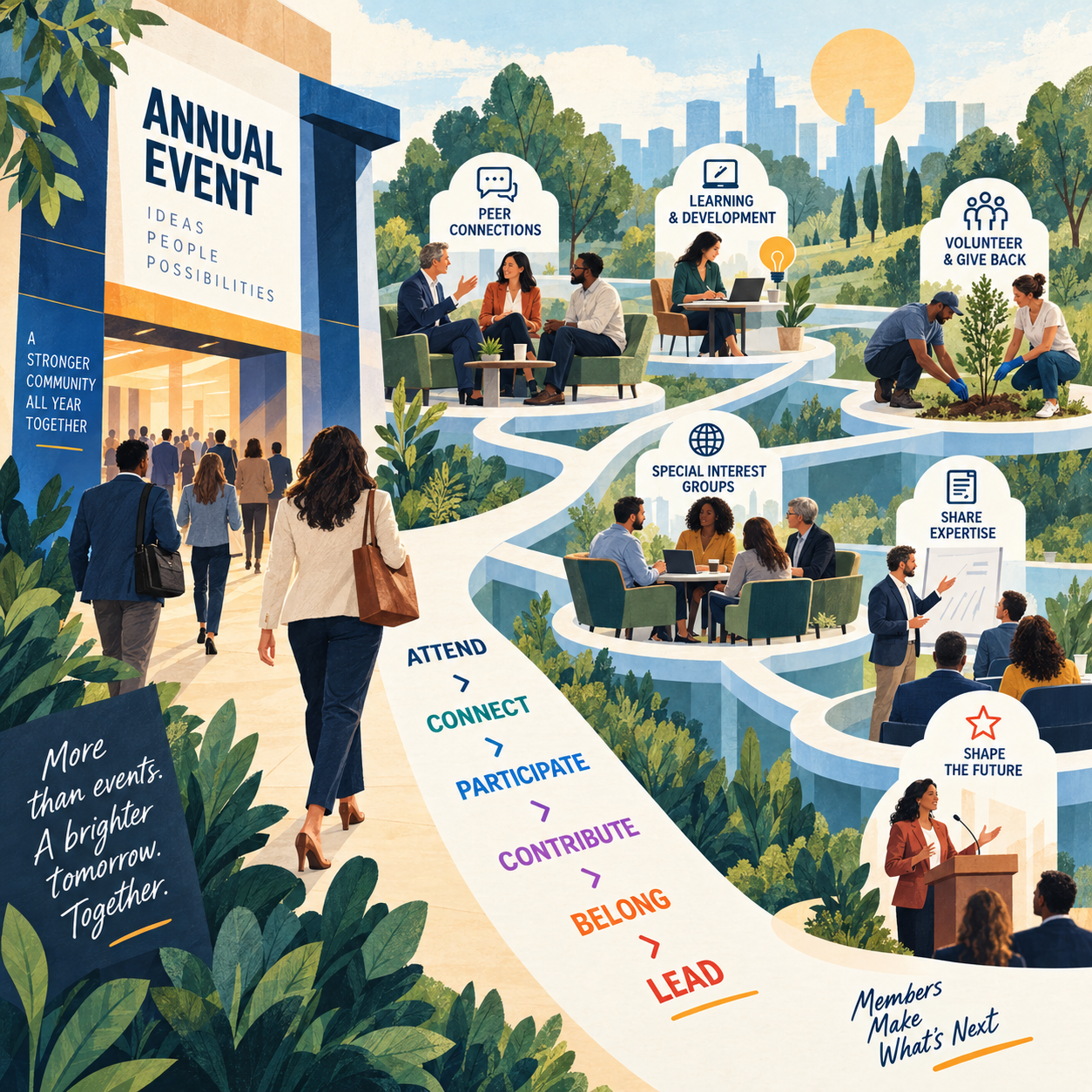
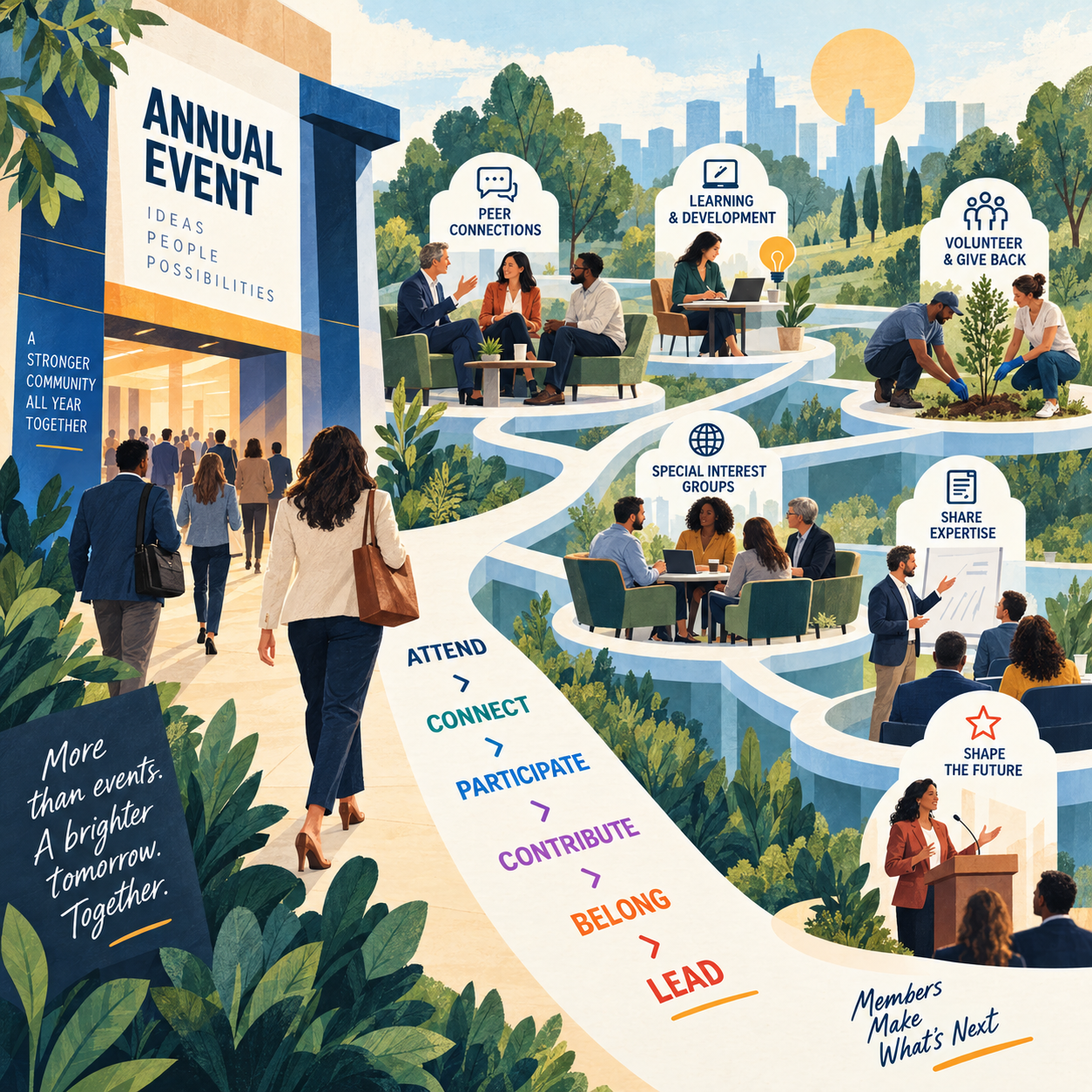
Attend → Connect → Participate → Return → Contribute → Belong → Lead
If that pathway is not visible, many willing members never take the next step. They may attend repeatedly without ever being invited into a committee, volunteer role, ambassador opportunity, or chapter contribution.
Practical ways to support progression include inviting engaged attendees to support a future event, promoting micro-volunteering opportunities, creating simple next-step journeys after major events, recognising contribution publicly, and giving members multiple ways to participate beyond attendance.
This helps associations reduce over-reliance on the same small group of active members and build a healthier long-term community.
10. Measure Engagement as Participation, Not Just Activity
This is where many associations fall short. They can report attendance and email performance, but still struggle to understand whether members are becoming more connected, involved, and likely to stay.
A stronger model measures participation signals that show whether the community is building momentum over time. That means looking beyond activity volume and asking whether members are progressing from awareness to attendance, from attendance to connection, and from connection to contribution.
What Associations Should Capture
A useful measurement model should show what to capture, how to capture it, who it helps, and what decision it should inform.
| What to capture | How to capture it | Who it helps | What decision it informs |
|---|---|---|---|
| Repeat participation | Event attendance across the calendar, webinar joins, chapter RSVPs, discussion activity, CRM history | Membership and event teams | Whether engagement is recurring or one-off |
| First-time to second-step conversion | Follow-up registrations, newcomer programme joins, second-event attendance within 30 to 90 days | Membership leaders | Whether new members are progressing or stalling |
| Topic interest | Session selections, content clicks, saved topics, poll responses, survey answers, chapter discussions | Programme and communications teams | Which themes should shape follow-up and future programming |
| Peer connection | Networking surveys, meeting bookings, introductions, discussion participation, post-event feedback | Community and event teams | Whether events are helping members build useful relationships |
| Contribution activity | Volunteer sign-ups, committee joins, speaker interest, ambassador activity, micro-contributions | Leadership and volunteer teams | Who may be ready for deeper involvement or leadership |
| Post-event momentum | Resource views, follow-up activity, chapter participation, repeat engagement after the flagship event | Executives and community leads | Whether event energy is carrying forward across the year |
| Friction points | Repeated member questions, low uptake of opportunities, low profile completion, drop-off after first activity | Operations and membership teams | Where discoverability, onboarding, or participation design needs improvement |
This table helps associations move from reporting activity to understanding participation. The aim is not to track every possible action. It is to identify which signals show whether members are becoming more connected, more involved, and more likely to continue.
How to Use These Signals
Collecting engagement data is only useful if it leads to better decisions. If first-time to second-step conversion is low, the issue may be onboarding or weak follow-up timing. If topic interest is high but repeat participation is low, the problem may not be relevance. It may be that the next-step pathway is unclear.
If peer connection is weak, the association may need stronger networking design, more visible groups, or better post-event continuity. If contribution activity depends on the same small group of people, the association may need smaller and more visible ways for members to get involved.
Better participation visibility also reduces the need for staff to act as the manual coordination layer across disconnected systems, scattered member signals, and one-off follow-up processes.
This is where association member engagement becomes more practical. The goal is not simply to gather more data. It is to turn fragmented signals into clearer community knowledge, so teams can spend less time coordinating manually and more time growing participation.
Common Mistakes Associations Make
Even well-run associations can undermine member engagement through a few repeatable mistakes.
Treating the Annual Event as the Whole Value Proposition
A major event matters, but it cannot carry a full year of member relevance on its own. If the rest of the year feels quiet, disconnected, or hard to navigate, the event becomes a temporary spike rather than a lasting source of value.
Over-Relying on Generic Communication
More emails do not fix weak relevance. If communication does not reflect what members care about, what they attended, or where they might want to participate next, it can feel like noise.
Leaving Connection to Chance
A networking break is not the same as a connection strategy. Members need clearer ways to find relevant people, enter conversations, and continue relationships afterwards.
Hiding Opportunities Across Too Many Channels
If members cannot easily find what is relevant, participation drops. This is especially risky when opportunities sit across separate chapter pages, newsletters, forms, spreadsheets, and event tools.
Measuring Activity Without Understanding Progression
Attendance is helpful, but it does not show whether members are moving towards contribution and belonging. Associations need to understand whether engagement is deepening, not just whether activity is happening.
Final Thought
The strongest associations do not win member engagement by creating more noise. They win by making participation easier to see, easier to enter, and easier to continue.
That means treating events as part of a broader community journey, not isolated peaks of attention. It means creating relevant touchpoints before, during, and after events. It means helping members move from attendance to connection, from connection to contribution, and from contribution to a stronger sense of belonging.
For association leaders and event managers, this is not just a community objective. It is also a retention, relevance, and growth objective. Better member engagement improves renewal confidence, strengthens event ROI, supports sponsor value, surfaces future leaders, and reduces the constant burden of rebuilding momentum from scratch.
Looking to Build Stronger Association Member Engagement?
SixSides helps associations turn major event momentum into clearer participation pathways, stronger member visibility, and more measurable year-round engagement.
For teams trying to create a more connected member experience before, during, and after major events, the Book a demo option on this page is there if you want to see how that could work in practice.
Give your event a community that lasts
A branded app where members show up before day one and stay long after the close. We'll walk you through it.
.png&w=800&q=75)