Blog
Event Community Guidelines: How to Set Expectations and Handle Concerns
When Event Participation Crosses the Line: How to Set Clear Community Guidelines
An Australian professional association is preparing for its annual conference of around 350 attendees. In the weeks before the event, members are invited into a digital community where they can introduce themselves, ask questions and discuss professional challenges.
Most of the conversation is useful until one participant begins posting promotional messages in unrelated discussions and sending unsolicited product pitches directly to other members.
The organiser now has a practical problem. Commercial discussion is not automatically inappropriate. Sponsors, suppliers and members may all have legitimate professional reasons to talk about products, services and industry solutions, but repeated unsolicited promotion is starting to interfere with the purpose of the community.
How should the organiser respond without discouraging legitimate professional interaction?
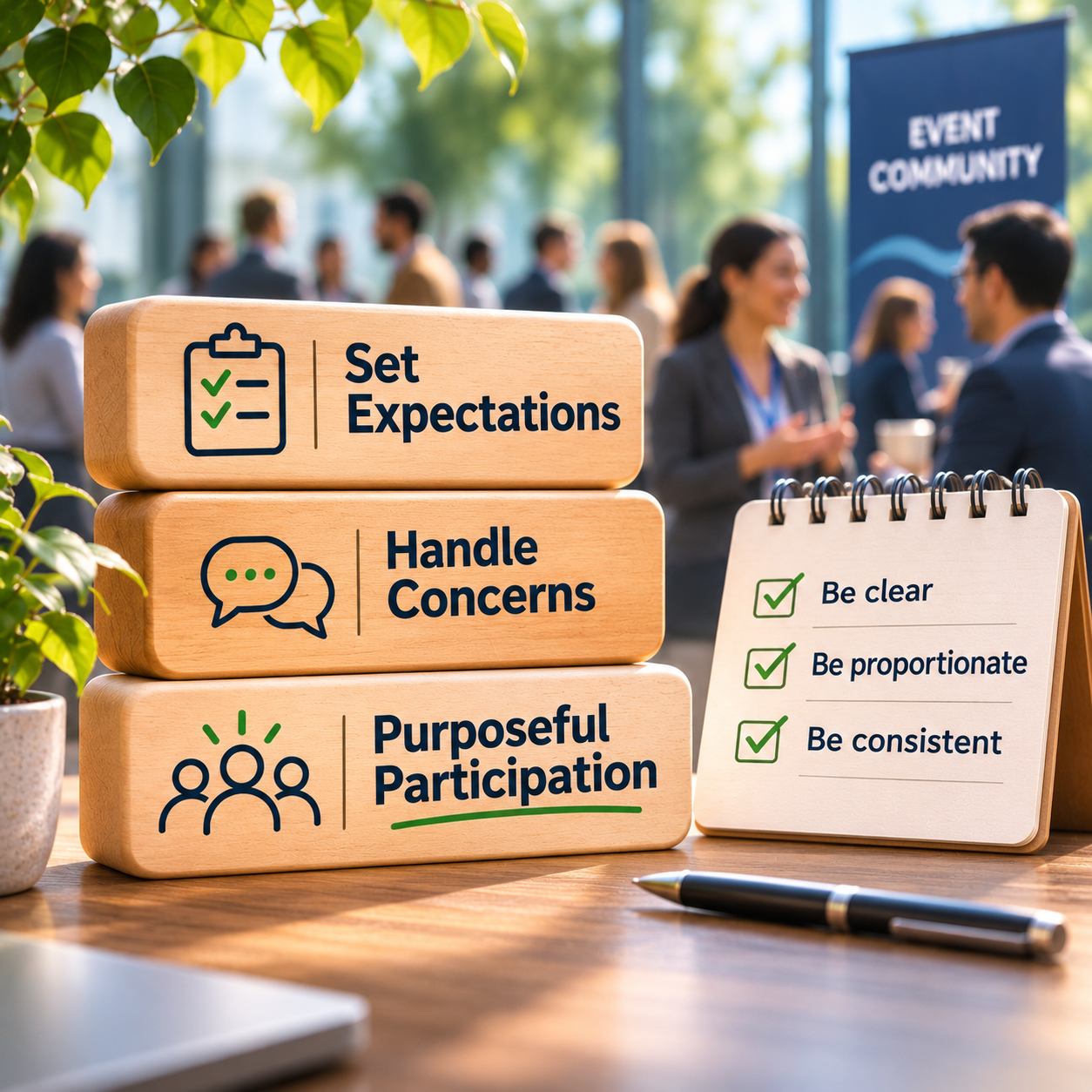
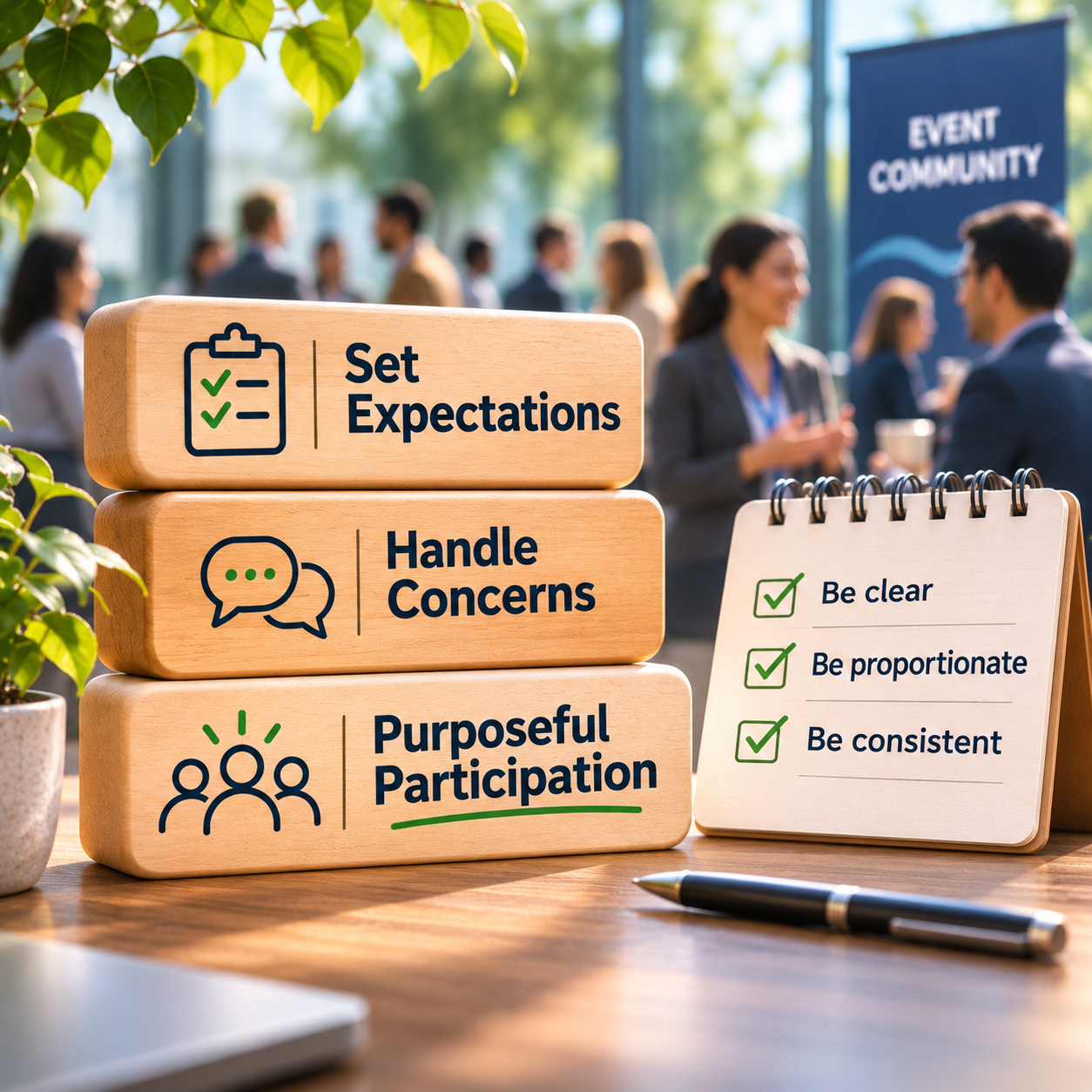
This is where event community guidelines become useful. They are not simply a list of things participants are forbidden to do. Good guidelines help people understand what the community is for, what useful participation looks like, where the boundaries sit and what happens if concerns arise.
Encouraging Participation Is Only Half the Job
Event organisers often spend considerable effort encouraging people to participate. They create introductions, discussion opportunities, community posts and ways for attendees to interact before, during and after the event.
But participation also needs enough structure to remain useful. A professional discussion can include disagreement. A member may share a relevant resource. A supplier may contribute useful expertise. Someone may promote an event, service or opportunity where it genuinely fits the conversation.
The challenge is not to eliminate these interactions. It is to establish expectations that help participants distinguish constructive contribution from behaviour that repeatedly disrupts, pressures or undermines the community experience.
For a broader look at the role people can play in facilitating useful interaction, see Why Events Need Community Hosts, Not Just Agendas.
Community hosts can help conversations happen. Community guidelines answer a different question: what standards should apply when people participate?
Community Guidelines Should Explain What Good Participation Looks Like
Weak guidelines often focus almost entirely on prohibited behaviour. They tell participants what not to do without explaining what the community is actually trying to support.
A more useful approach describes both sides.
Participation You Want to Encourage
Depending on the event, that might include:
- respectful professional discussion
- relevant questions and shared experience
- constructive disagreement
- useful resources
- appropriate peer support
- respect for participants' time and privacy
Participation That Crosses Appropriate Boundaries
Examples might include:
- repeated unsolicited promotional messages
- harassment or personal attacks
- persistent disruption of discussions
- sharing private information without permission
- inappropriate representations of other participants
The aim is not to produce the longest possible list. Guidelines should be proportionate to the event, audience and type of community interaction taking place.
A highly technical professional conference may need different examples from a volunteer-led association gathering. What matters is that participants can reasonably understand the standards that apply.
Community Guidelines and a Code of Conduct Are Not the Same Thing
Many associations and professional organisations already have a formal code of conduct. That may cover broader behavioural expectations, reporting responsibilities, disciplinary procedures or organisational obligations.
Community guidelines serve a narrower practical purpose. They help participants understand how they are expected to interact in specific event and community environments.
The two can complement each other. For example, an association's formal code of conduct may establish overarching expectations around respectful behaviour, while its event community guidelines explain what those expectations mean in an online discussion space, a conference community or a member-led conversation.
Community guidelines should not be treated as a substitute for applicable organisational policies, safeguarding procedures, legal obligations or specialist advice.
Build Guidelines Around the Purpose of the Community
Before writing rules, define what the community exists to support.
Suppose an association's pre-conference discussion space exists to help members exchange professional knowledge, ask relevant questions, discover useful people and continue conversations around conference themes. That purpose provides context for deciding what belongs.
A practical framework is:
| Question | What organisers should establish |
|---|---|
| What is this community for? | The purpose of the discussions and activities |
| What participation is encouraged? | Relevant contributions, questions and professional exchanges |
| What boundaries are needed? | Expectations around respect, privacy, promotion and appropriate behaviour |
| Who maintains those expectations? | The organiser or designated community management team |
| How can participants raise concerns? | A clear and accessible contact or process |
| How will concerns be reviewed? | A proportionate process aligned with existing organisational policies |
For many event teams, the first version of community guidelines does not need to be long. It needs to be clear enough that participants understand the purpose of the space, the main boundaries and how to raise a concern.
That is enough to give a smaller team a workable foundation without creating a large governance structure for every interaction.
Make Promotional Boundaries Specific Enough to Understand
Professional event communities often need particular care around commercial participation.
A rule such as:
No promotion.
may be too broad.
A supplier answering a technical question with relevant expertise is different from repeatedly posting sales messages into unrelated discussions. Similarly, a sponsor contributing to an agreed commercial session is different from sending unsolicited pitches to individual attendees.
A clearer guideline might explain:
Relevant professional resources and commercial discussion are welcome where they contribute to the conversation. Repeated unsolicited promotion or direct sales messages to participants are not appropriate in general community discussions.
That tells participants what is allowed as well as where the boundary sits.
The goal is not to remove commercial participation. It is to keep it relevant to the purpose of the community.
Communicate Expectations Before Problems Arise
Guidelines are more useful when people know they exist before something goes wrong.
Relevant expectations might be introduced through:
- registration or onboarding information
- pre-event communications
- community welcome messages
- participation information
- reminders before particular activities
- an easily accessible guidelines page
That does not mean copying a lengthy policy into every email. The important information should be easy to understand and easy to find.
For example, a welcome message might briefly explain that constructive professional discussion, questions and resource sharing are encouraged, while repeated unsolicited promotional messages are not. Participants can then access the full guidance if they need more detail.
Be Clear About Who Is Responsible
Responsibility for community standards should not be ambiguous.
Depending on the organisation, the people involved may include an event manager, community manager, designated association staff, appropriately briefed community hosts or another responsible organisational representative.
But not everyone involved in supporting the community needs the same authority. A host may notice an issue or help a participant find the right contact. That does not mean the host should investigate complaints or decide disciplinary outcomes.
Before the event, establish three things:
- Who receives concerns?
- Who decides what response is appropriate?
- Who should be contacted if the concern involves the usual responsible person?
For smaller teams, this may simply mean identifying one primary contact and one alternative. Clarity matters more than building a complex structure.
Use a Proportionate Response Framework When Concerns Arise
Not every concern requires the same response.
A disagreement between two professionals is not automatically misconduct. A misunderstanding about promotional boundaries should not automatically be treated the same way as harassment, threatening behaviour or another serious concern.
A practical response framework can help organisers make more consistent decisions.
Step 1: Understand the Concern
Establish what happened and gather enough context to understand the situation.
Ask:
- What interaction is being raised?
- Which guideline may be relevant?
- Is this disagreement, misunderstanding or potentially inappropriate conduct?
- Does an existing organisational policy apply?
Avoid drawing conclusions from a single fragment when more context is reasonably available.
Step 2: Consider the Level of Response
Match the response to the nature and seriousness of the concern.
A lower-level misunderstanding may require clarification. Repeated behaviour may require a firmer response.
More serious safety, harassment, discrimination or threatening behaviour should be handled through the organisation's established policies and appropriate professional or safety procedures rather than treated as an ordinary community-management issue.
Step 3: Respond Through the Appropriate Channel
Where the concern is lower-level, a private conversation may be more appropriate than a public correction.
Explain what behaviour caused concern, which expectation applies and what needs to change. Avoid publicly escalating a situation unnecessarily.
Step 4: Apply Expectations Consistently
Similar situations should generally receive similar treatment, while still allowing reasonable judgement about context and severity.
Consistency means participants and staff should not be left guessing whether the same behaviour will be acceptable depending on who is involved.
Step 5: Document and Review Where Appropriate
Maintain whatever records are necessary under the organisation's policies and privacy obligations.
Then ask whether the situation revealed a problem with the guidelines themselves. Was the expectation unclear? Did participants know where to raise concerns? Did staff know who was responsible?
Sometimes the incident is also feedback on the operating process.
Example: Repeated Unsolicited Promotion in an Association Community
Return to the 350-person professional association conference.
Its pre-event digital community encourages members to introduce themselves, discuss industry issues and exchange relevant resources. One participant begins posting product promotions across unrelated discussions and sending unsolicited pitches directly to other members.
Several attendees raise the issue. The organiser already has guidelines stating that relevant commercial conversation is acceptable, but repeated unsolicited promotion is not.
First: Understand What Happened
The community manager reviews the reported activity and the relevant guidelines.
The issue is not simply that the participant represents a commercial organisation. It is that repeated promotional messages are appearing in conversations where they are not relevant, and members are receiving pitches they did not request.
Second: Clarify the Boundary
The organiser contacts the participant privately. They explain what has been reported, point to the relevant expectation and clarify that professional commercial discussion remains welcome where it is relevant.
If the event provides appropriate channels or activities for commercial participation, the organiser can also explain where those conversations are better placed.
Third: Respond Proportionately
If the participant understands the expectation and the behaviour stops, no further action may be required.
If it continues, the organiser follows the association's established policies and available procedures. The response becomes firmer because the issue is now repeated behaviour after the boundary has already been clarified.
Fourth: Review the Community Experience
The team checks whether the promotional guideline was clear enough and whether participants knew how to raise concerns.
The lesson is not that commercial participation is bad. It is that commercial participation needs enough context and boundaries that professional discussion remains useful for everyone involved.
Apply Guidelines Across Physical and Digital Event Spaces
An event community no longer exists only inside a conference venue.
Participation may happen through:
- pre-event introductions
- digital discussion spaces
- in-person sessions
- networking activities
- community posts and comments
- relevant follow-up conversations
The exact behaviour may differ between settings, but the underlying expectations should remain reasonably consistent.
Respectful professional interaction should not stop being expected when the conversation moves online. Likewise, guidelines written only for digital posts may miss conduct occurring during physical event activities.
Organisers do not need a separate rulebook for every touchpoint. They need principles that make sense across the places where community interaction actually occurs.
Respectful Disagreement Should Still Be Possible
Professional communities benefit from differing views. A strong set of guidelines should not make participants afraid to challenge ideas, question assumptions or disagree with another member.
The boundary is usually about **how **that disagreement happens.
Compare:
I disagree with that recommendation because our regional programme produced a different outcome.
with:
Anyone who believes that clearly has no idea what they're doing.
The first challenges an idea. The second attacks the person.
Community guidelines should preserve room for constructive disagreement while making personal attacks and other inappropriate behaviour easier to recognise.
How Do You Know Whether the Guidelines Are Working?
Do not judge success simply by counting how few concerns are reported.
A low number could mean participants understand the expectations. It could also mean they do not know how to raise an issue or do not feel confident doing so.
Instead, review signals such as:
| What to review | What it may tell you |
|---|---|
| Whether participants know where guidelines are | Whether expectations are visible enough |
| Whether people know how to raise concerns | Whether reporting pathways are understandable |
| Repeated questions about behaviour | Where guidance may still be unclear |
| Recurring types of concerns | Where boundaries may need better explanation |
| Staff understanding of responsibilities | Whether the organiser response is workable |
| Participant feedback | Whether guidelines support rather than discourage useful participation |
| Changes in the community | Whether expectations need updating over time |
Guidelines should not be written once and forgotten. As the event community evolves, new types of participation may create new questions.
Periodic review keeps the guidance relevant without turning it into unnecessary bureaucracy.
Common Event Community Guideline Mistakes
Writing Guidelines That Are Too Vague
“Be respectful” is a useful principle, but participants may still need examples of what that means in practice.
Creating Policies Nobody Can Easily Find
Even appropriate guidance is less useful when attendees do not know it exists.
Focusing Only on Prohibited Behaviour
Tell people how they can participate constructively as well as what crosses the boundary.
Failing to Assign Responsibility
If nobody knows who receives concerns or makes decisions, even clear guidelines can become difficult to apply.
Responding Inconsistently
Uneven responses create uncertainty about whether the standards actually mean anything.
Treating Disagreement as Misconduct
A professional community should still have room for respectful debate.
Assuming Technology Replaces Organiser Judgement
Community tools can support communication and participation, but they do not remove the organiser's responsibility to establish appropriate expectations and follow the organisation's relevant policies and processes.
Where SixSides Fits
SixSides supports community posts, comments, reactions, organiser communication and shared event community experiences. Those capabilities create places where professional interaction and community participation can happen.
But community standards remain primarily an organiser responsibility.
SixSides should not be understood here as a specialist moderation, safeguarding, compliance or incident-management platform. The useful connection is simpler: when organisers create more opportunities for people to participate, clear expectations help those opportunities remain purposeful and respectful.
Technology can support the community environment. The organiser still defines what appropriate participation means.
Final Thought
Good community guidelines are not designed to make an event community quieter. They are designed to make participation clearer.
People should understand what the space is for, what kinds of contributions are welcome, where appropriate boundaries sit and what they can do if something goes wrong. Organisers, in turn, should know who is responsible and how to respond proportionately.
Encouraging participation is only part of building a valuable event community. Clear expectations help protect the quality of that participation without turning community management into policing.
Create Clearer Expectations Around Event Participation
If your event already creates useful conversations before, during and after the programme, the next step may be making the expectations around those interactions just as clear as the opportunities themselves.
SixSides supports the community participation where those conversations take place. The Book a demo option on this page is there if you want to explore how that participation layer could fit around your own event community.
Give your event a community that lasts
A branded app where members show up before day one and stay long after the close. We'll walk you through it.
Related articles
Event Gamification for Associations: Chapter-Based Events and Membership Databases
November 04, 2026Rhea Mae Mangubat

Association Community Apps for Year-Round ROI: What to Measure Before You Buy
November 03, 2026Chris Igos
How to Choose Event Gamification Software for Conferences
November 02, 2026Rhea Mae Mangubat