Blog
Association Conferences: Member and Non-Member Participation
Association Conferences: What Should Be Shared, Member-Specific or Conditional?
An Australian professional association is planning its national conference. Members will attend, but so will professionals who are not part of the association.
Some activities clearly belong to the wider conference programme. A technical keynote, for example, may be relevant to anyone working in the profession. Other activities have a different purpose. The association's formal member meeting involves specific governance responsibilities, while a specialist workshop has limited places and requires particular experience.
The organising team therefore faces a practical question:
Which conference experiences should be shared, which should remain member-specific and which need other participation conditions?
The answer should not begin with an assumption that members and non-members need completely different conference experiences. Nor should organisers assume that opening every activity to everyone automatically improves participation.
A more useful approach is to start with the purpose of each activity and work outwards from there.
A valuable association conference does not require identical experiences for every delegate. It requires purposeful decisions about shared participation, membership-specific responsibilities and other eligibility conditions where they genuinely support the activity's purpose.
1. Start With the Purpose, Not the Membership Status
Members and non-members may have different relationships with an association, but neither group is uniform.
One member may attend primarily for technical professional development. Another may be involved in association governance or leadership. A non-member may be an experienced specialist with useful knowledge to contribute, while another may simply be attending to understand developments in the profession.
That makes blanket participation rules difficult to justify.
Instead of starting with:
Should this be for members or non-members?
start with:
What is this activity trying to achieve, and who needs to participate for that purpose to be fulfilled?
Consider several conference activities.
A technical presentation may exist to share professional knowledge. An industry discussion may benefit from people bringing experience from different organisations. A formal members' meeting may involve governance rights that belong specifically to association members. A specialist workshop may require a particular level of professional experience regardless of membership status.
Those activities do not need the same participation model.
A useful decision process is:
Activity Purpose → Relevant Participants → Necessary Conditions → Intended Participation Experience → Clear Communication
For each activity, organisers should consider:
- What is this activity intended to achieve?
- Who has relevant knowledge or experience to contribute?
- Who would benefit from participating?
- Are any restrictions genuinely necessary?
- Does the activity fulfil a specific membership responsibility?
- Are there practical conditions such as capacity, experience or prior registration?
- How will eligible participants understand what is available to them?
The guiding principle is:
Participation design should follow the purpose of the activity rather than applying blanket restrictions based on membership status.
2. Use Three Participation Models
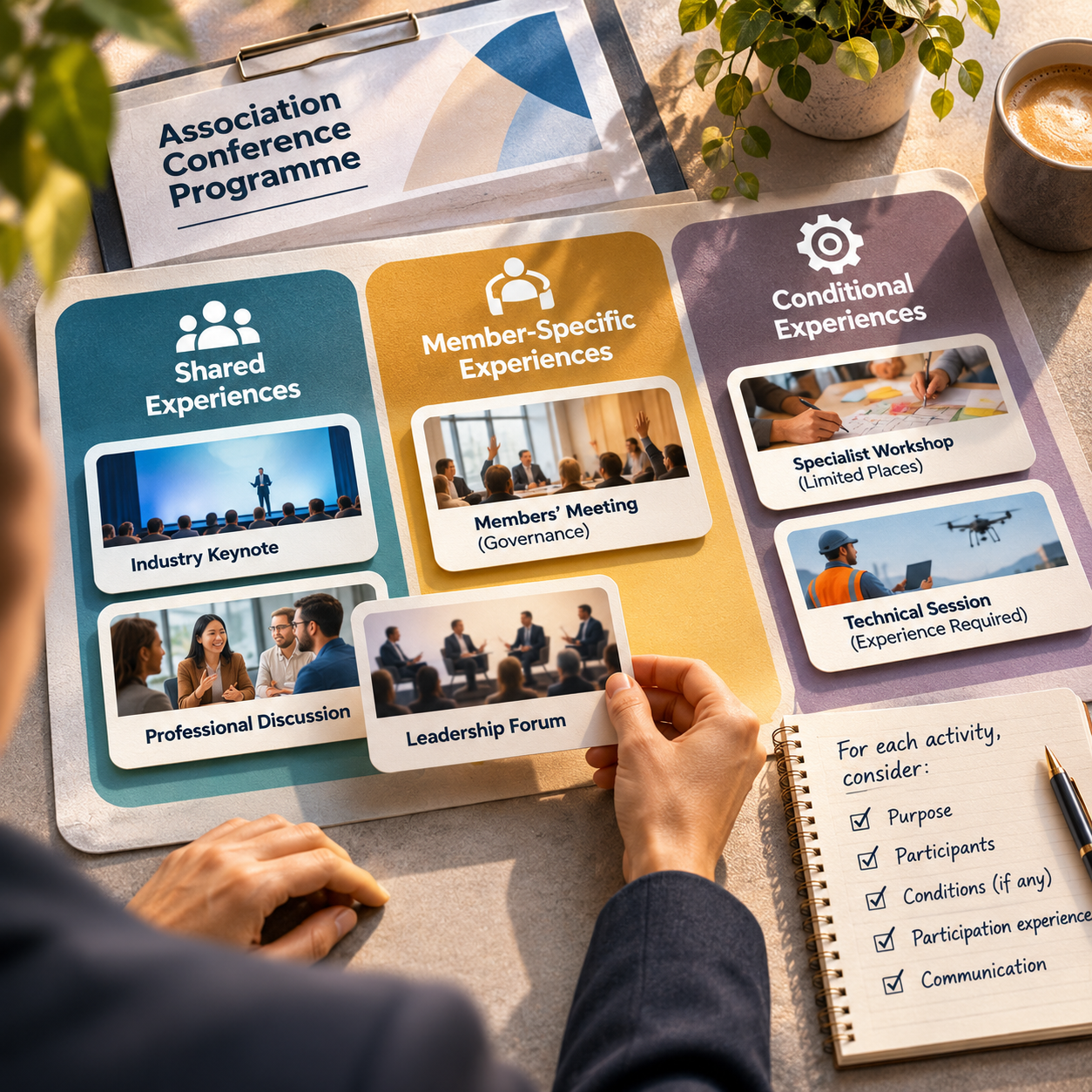
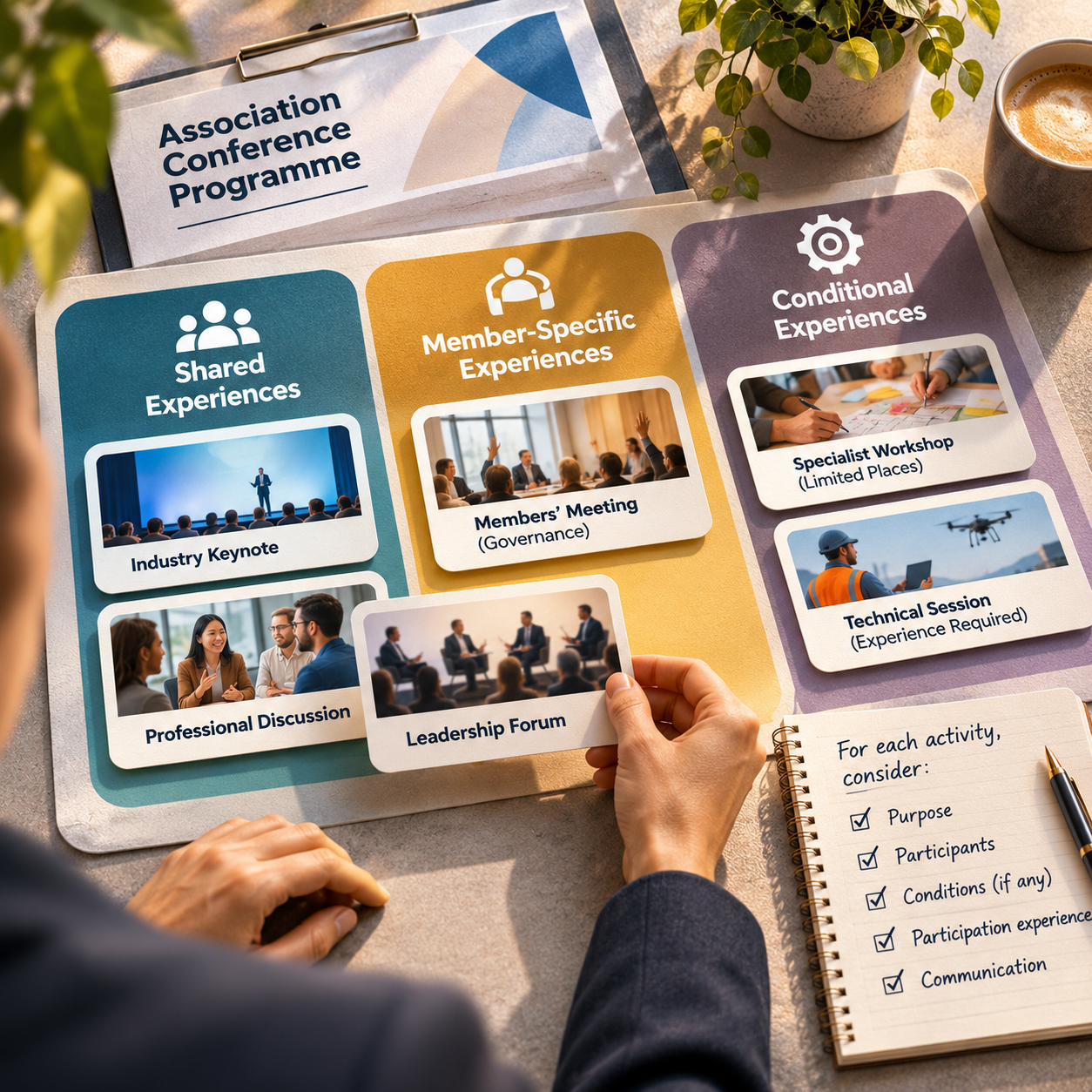
A practical way to plan conference participation is to consider three broad models: shared experiences, member-specific experiences and purpose-specific or conditional experiences.
These are planning routes rather than rigid classifications. One activity may involve more than one condition.
Shared Conference Experiences
Shared experiences are activities where broader participation supports the purpose.
Examples might include:
- main conference presentations
- industry discussions
- professional development sessions
- exhibitions
- selected networking activities
- broader professional conversations
An industry keynote, for example, may be relevant to professionals across the sector regardless of whether they belong to the organising association.
A shared professional discussion may also benefit from people bringing experience from different employers, sectors or parts of the profession.
The reason to make an activity shared should not simply be that open access feels more inclusive.
It should be because broader participation helps the activity fulfil its purpose.
Member-Specific Experiences
Some activities have a legitimate reason to be designed specifically for association members.
Examples may include:
- formal member governance meetings
- association business
- member leadership activities
- activities connected to particular membership responsibilities
- selected programmes associated with established member roles or benefits
A formal members' meeting is a straightforward example. If the activity exists to fulfil governance responsibilities, participation should follow the association's relevant rules and obligations.
The important distinction is that restriction serves an organisational purpose.
Exclusivity itself should not be treated as evidence that an activity is more valuable.
The stronger question is:
Does membership itself provide a legitimate reason for a different participation arrangement?
Where the answer is yes, a member-specific experience may be appropriate.
Purpose-Specific or Conditional Experiences
The third category is particularly important because not every restricted activity should be restricted according to membership status.
Some experiences need other conditions.
Examples may include:
- limited-capacity technical workshops
- specialist professional development
- leadership programmes
- discussions requiring particular professional experience
- invitation-based programmes
- activities requiring advance registration
Imagine a technical workshop that assumes participants already have experience with a particular professional process.
A non-member with that background may be highly relevant to the session, while an association member without it may not be the intended participant.
In that case, professional relevance is the participation condition, not association membership.
Other activities may be limited because of room capacity, the format of the session or the responsibility participants hold in their organisations.
This avoids reducing every conference access decision to a members-versus-non-members choice.
An Illustrative Participation Framework
| Activity | Purpose | Participation approach |
|---|---|---|
| Industry keynote | Share professional knowledge | Open to eligible registered delegates |
| Technical workshop | Develop practical skills | Based on registration, relevance or capacity |
| Member governance meeting | Fulfil association responsibilities | Follow membership and governance requirements |
| Industry networking session | Support professional exchange | Shared participation where appropriate |
| Member leadership forum | Address member leadership responsibilities | Member-specific where justified |
| Specialist discussion | Exchange relevant experience | Based on the discussion's purpose |
These examples are not universal rules.
The organiser still needs to consider the actual purpose, responsibilities and participant context surrounding each activity.
3. Build One Coherent Conference, Not Two Separate Experiences
Shared, member-specific and conditional activities can coexist within the same conference without creating one event for members and another for non-members.
The programme becomes easier to understand when each participation decision has a clear reason behind it.
Make Shared Participation Worthwhile
Where people participate together, there should be a genuine purpose for doing so.
An industry discussion may benefit from broader professional perspectives. A technical presentation may be relevant across the profession. An exhibition may serve the full registered conference audience.
The aim is not simply to place different groups in the same room.
The experience should give the people who are there an appropriate opportunity to listen, contribute, discuss or participate according to the purpose of the activity.
Make Member-Specific Activities Purposeful
Member-specific activities should connect to a genuine organisational responsibility, established role or relevant member purpose.
Formal association business naturally creates a different participation arrangement from an industry keynote.
What organisers should avoid is adding restrictions simply to make an activity appear more exclusive.
Member-specific should describe a reason for participation, not a default design rule.
Use Conditional Participation When the Activity Requires It
Some sessions need limits because of capacity, professional experience or programme design.
A leadership discussion may require participants to hold particular responsibilities. A practical workshop may have limited places because of how it is delivered. A specialist session may assume prior technical knowledge.
These conditions can be entirely appropriate when they support the intended experience.
The important question is whether the restriction has a clear relationship to what the activity is trying to achieve.
4. Make Participation Arrangements Easy to Understand
Even sensible participation rules create frustration when delegates cannot tell what they are eligible to attend.
Conference programmes and registration information should clearly identify:
- activities open to registered delegates
- member-specific activities
- other eligibility requirements
- advance registration requirements
- capacity limits
- where the current programme information can be found
- who to contact if eligibility is unclear
The language does not need to be complicated.
For example:
Open to all registered delegates
Association members only
Advance registration required
For senior practitioners
Limited capacity
Prior experience required
The wording should reflect the actual condition.
Avoid making delegates infer eligibility from vague programme descriptions or discover a restriction only when they arrive at the session.
This communication should remain simple. The purpose is not to build another event communication framework, but to make participation arrangements understandable before someone decides where to spend their time.
5. Example: An Australian Professional Association Conference
Imagine a fictional Australian professional association representing people working across the built environment.
Its annual conference attracts both association members and non-member professionals. The organising team wants to deliver a relevant industry programme while still fulfilling responsibilities that belong specifically to the association and its members.
Rather than applying one participation rule across the event, it considers each activity separately.
Decision 1: Shared Professional Learning
The conference opens with a technical keynote covering changes affecting the built-environment sector.
The purpose is professional learning, and the content is relevant across the industry.
The organising team therefore makes the session available to all appropriately registered conference delegates.
There is no clear programme reason to restrict it according to membership status.
Decision 2: Member Governance
Later that day, the association holds its formal members' meeting.
The activity exists to conduct association business and involves responsibilities governed by the organisation's established rules.
Participation therefore follows the relevant membership and governance requirements.
The restriction exists because of the purpose of the meeting, not because restricted access is inherently more valuable.
Decision 3: Specialist Professional Development
A practical workshop examines a specialist technical process.
Places are limited, and the workshop assumes participants already have experience in the field.
The organiser therefore uses purpose-specific conditions. Participation depends on professional relevance, advance registration and available capacity rather than membership status alone.
A suitably experienced non-member may be appropriate for the workshop, while a member without the required background may choose another session.
Decision 4: Shared Professional Discussion
The programme includes an industry discussion about workforce capability across regional and metropolitan organisations.
The organisers believe the conversation will benefit from people working in different organisational environments.
The session is therefore open to eligible registered delegates, allowing members and non-members with relevant experience to contribute.
Decision 5: Member Leadership Activity
A separate session is designed for people currently serving in association chapter and committee leadership roles.
Its purpose is to help those volunteers discuss responsibilities specific to their association positions.
Participation is therefore restricted according to the role participants hold within the association.
Again, the condition follows the purpose.
Decision 6: Make the Logic Visible
The conference programme identifies whether activities are shared, member-specific or subject to another condition.
Delegates can understand where they can participate before the conference rather than discovering restrictions at the session door.
The association has not created two separate conferences.
It has created one conference with different participation models where the programme genuinely requires them.
6. Evaluate Whether the Participation Design Worked
Overall conference attendance or satisfaction alone may not reveal whether the participation arrangements were appropriate.
A more useful review considers whether each model supported the purpose of the activity.
| Evaluation question | What it helps organisers understand |
|---|---|
| Did delegates understand which activities were available to them? | Participation clarity |
| Were activities relevant to their professional interests? | Programme relevance |
| Did shared sessions provide useful opportunities to contribute? | Whether broader participation supported the activity |
| Did member-specific activities fulfil their intended purpose? | Whether member-specific participation was justified |
| Were any restrictions confusing or unnecessary? | Potential participation barriers |
| Did conditional activities attract the intended participants? | Whether eligibility criteria matched the activity |
| What would delegates change next time? | Opportunities to improve future programme design |
Keep the evaluation proportionate.
A conference team may only need several focused feedback questions and an internal programme review rather than a complex measurement process.
It is also important not to interpret participants through simplistic assumptions.
Members are not necessarily attending primarily for association business. Non-members should not automatically be treated as potential membership conversions.
The relevant question is:
Did the participation design help each activity fulfil the purpose it was created for?
Where SixSides Fits
SixSides is a community-first event engagement platform designed to support connection, participation and ongoing community value around events.
That makes it relevant to the participation layer surrounding an association conference. Community conversations, attendee networking, participant contributions and other event interactions can help delegates discover and participate in relevant experiences.
But the organiser still determines the participation model.
SixSides should not be positioned as automatically verifying association membership, administering eligibility, enforcing member-only access rules or deciding which delegates belong in a particular activity.
SixSides' relevance here is meaningful participation, not membership access administration.
Technology can support the environment around the programme. The association still needs to decide what each activity is for, who should be able to participate and whether any conditions are genuinely necessary.
Final Thought
Association conferences do not need to apply one participation rule to every programme activity.
Some experiences benefit from the wider professional community. Some legitimately involve responsibilities specific to association members. Others need conditions based on professional relevance, capacity, role or programme design rather than membership status.
The stronger approach is to examine each activity individually: define its purpose, identify who can participate meaningfully and apply only the conditions necessary to support that experience.
A valuable association conference does not require identical experiences for every delegate. It requires purposeful decisions about shared participation, member-specific responsibilities and appropriate eligibility conditions.
Design Participation Around Purpose
If your conference brings together people with different relationships to the association, the goal does not need to be creating separate experiences for each audience.
Start with what each activity is trying to achieve and build the participation model from there.
SixSides can support the wider connections and community participation around those conference experiences, while the association remains responsible for deciding which opportunities should be shared, member-specific or conditional.
Give your event a community that lasts
A branded app where members show up before day one and stay long after the close. We'll walk you through it.