Blog
Why Event Engagement Drops After the Event and How to Build Momentum Instead
Your event went well. People showed up, sessions were full, energy was high, and the day felt like a success.
By most traditional measures, it probably was.
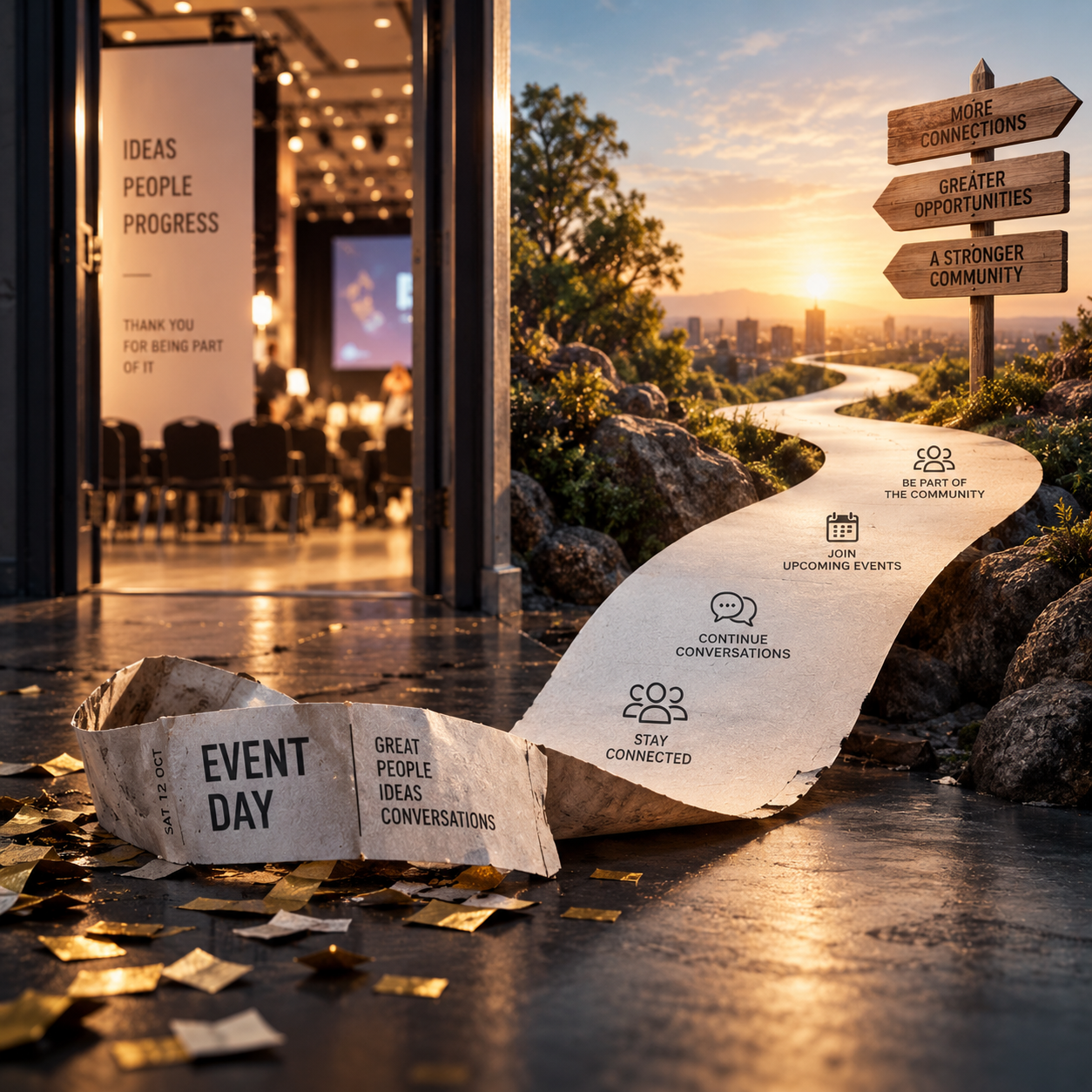
But then the event ended, and everything seemed to stop. The conversations slowed down. Attendees returned to work. Sponsor engagement faded. The energy that felt strong in the room did not carry forward in any meaningful way.
This is one of the most common problems in events, and it is also one of the easiest to overlook.
Many event teams put significant effort into planning what happens before and during the event, but far less attention is given to what happens after it. The result is that post-event engagement is often treated as a follow-up task rather than a designed part of the event experience.
That is where momentum gets lost.
Why engagement drops after events
It is easy to explain post-event drop-off by saying people are busy or that everyone simply goes back to work. There is some truth in that, but it is not the full reason engagement disappears.
The deeper issue is that many events are not designed to continue.
Most events are planned as complete experiences. They have a clear start, a packed middle, and a defined end. Once that end arrives, there is often no natural next step for attendees, sponsors, speakers, or community members.
Connections may have been made, but they were not strong enough to carry forward. Conversations may have started, but there was no clear reason to continue them. People may have enjoyed the day, but they were not given a simple path to stay involved afterwards.
So they default to doing nothing.
This is not because people do not care. It is because people do not continue events. They continue value.
If nothing valuable carries forward, engagement disappears.
The hidden cost of post-event drop-off
Post-event drop-off is not only an engagement problem. It is a value problem.
Most event teams invest heavily to get people into the room. They spend time and budget on marketing, speakers, production, sponsorship, operations, partnerships, content, and attendee experience.
When engagement stops as soon as the event ends, much of that investment starts to lose its long-term value.
The cost often shows up quietly. Promising conversations do not turn into opportunities. Attendees who were interested on the day do not stay involved. Sponsors receive visibility during the event but fewer meaningful touchpoints afterwards. Speakers may deliver strong sessions, but the discussion ends when the room clears.
For associations and membership organisations, the impact can be even greater. If members attend an event but do not feel more connected to the community afterwards, the event has only delivered part of its potential value.
A successful event should not only create a good experience on the day. It should create something that continues.
Events should create momentum, not just moments
Most events are designed as moments. They focus on the event day, the agenda, the content, the attendance, and the experience in the room.
Those things matter. A strong moment can create energy, attention, and shared experience.
But event value is not created only in the moment. It is often created in what happens after the moment.
The best events do more than deliver a strong day. They create momentum.
Momentum means conversations continue. Relationships develop. Attendees stay connected. Sponsors have more meaningful engagement. Organisers have a clearer way to carry the energy of the event into the wider community.
That is the difference between an event that people attend and an event that continues to matter.
Momentum starts during the event
Post-event engagement does not begin after the event. It starts during the experience itself.
If attendees do not have meaningful interactions during the event, there is usually very little to continue afterwards. If the right conversations never happen, there is no natural follow-up. If people do not discover who is relevant to them, they are unlikely to reconnect later.
Momentum depends on creating interactions that feel worth continuing.
That means event teams need to think beyond attendance and session delivery. They need to consider how people are meeting, what kinds of conversations are being encouraged, and whether attendees have a reason to reconnect after the event ends.
A post-event email or survey can be useful, but it cannot create momentum by itself. Momentum comes from the quality of connection built throughout the event journey.
Relevant connections are what carry forward
People are more likely to stay engaged when the connections they make feel relevant.
A random conversation may be pleasant, but a relevant conversation is more likely to continue. That relevance might come from a shared challenge, a similar role, a common interest, a useful introduction, or a conversation that connects directly to what the attendee is trying to achieve.
This matters for attendees, but it also matters for sponsors, speakers, partners, and organisers.
Sponsors want more than visibility. They want meaningful interaction with the right people. Speakers want their ideas to continue beyond the session. Associations want members to build stronger relationships with each other and with the wider community.
When connections are relevant, the event becomes more than a one-day experience. It becomes a starting point for future conversations.
People need a reason to reconnect
Even strong interactions can fade if there is no clear reason to continue.
An attendee may meet someone useful during a session break, but if the next step is unclear, the conversation may stop there. A sponsor may have a good conversation with an attendee, but without a natural follow-up pathway, that opportunity may not develop. A member may feel energised by the event, but without continued community touchpoints, that energy can disappear quickly.
This is why post-event momentum needs structure.
There should be a reason to reconnect. That reason might be a shared goal, an ongoing discussion, a future event, a community activity, a follow-up resource, or a simple way to continue a conversation that started on the day.
Without that reason, even positive engagement can become temporary.
Designing beyond the event day
The shift for many organisers is to stop thinking of events as isolated moments and start thinking of them as journeys.
That means considering what happens before the event, how people connect during the event, and what continues after it.
Before the event, organisers can help attendees understand who will be there, what topics matter, and where relevant conversations may happen. During the event, they can make it easier for people to discover each other, participate confidently, and start useful conversations. After the event, they can create simple pathways for those conversations to continue.
This is especially important for community-led events, association events, recurring event series, and sponsor-backed programmes. In these environments, the event is not only about delivering content. It is about strengthening the network around the event.
The better question is not only, “How do we run a great event?”
The better question is, “What should happen because this event existed?”
Post-event momentum is part of event engagement
Event engagement should not stop when the venue closes.
If the goal is to build stronger attendee relationships, improve sponsor value, support community participation, and create lasting impact, the post-event experience needs to be designed with the same care as the event day itself.
That does not mean adding more noise or sending more generic follow-ups. It means creating a clear connection between the event experience and what comes next.
The most effective events give people a reason to stay involved. They make it easier for attendees to reconnect, continue useful conversations, and remain part of the wider community.
That is how events move from short-term engagement to long-term value.
Final thought
Most events are judged by what happens on the day. Attendance, energy, session feedback, and operational delivery all matter.
But the real value of an event is often decided afterwards.
Not only by how well it ran, but by what continued.
If conversations stop, relationships fade, sponsor engagement disappears, and community energy drops, the event may have created a strong moment without creating lasting momentum.
The opportunity for organisers is to design beyond the event day.
Because if nothing carries forward, you did not build momentum.
You built a moment.
Looking to create more meaningful connections at your events?
Book a call with the SixSides team to see how community-led event engagement can improve attendee participation, networking, and event outcomes.
Give your event a community that lasts
A branded app where members show up before day one and stay long after the close. We'll walk you through it.